Blog

  • NVIDIA (NVDA): Jensen Huang in Return Talks Four Days After Resigning — Petition Tops 159,089, Kalshi Puts a Comeback at 13%

    NVIDIA (NVDA): Jensen Huang in Return Talks Four Days After Resigning — Petition Tops 159,089, Kalshi Puts a Comeback at 13%

    Hello from Bota Labo.

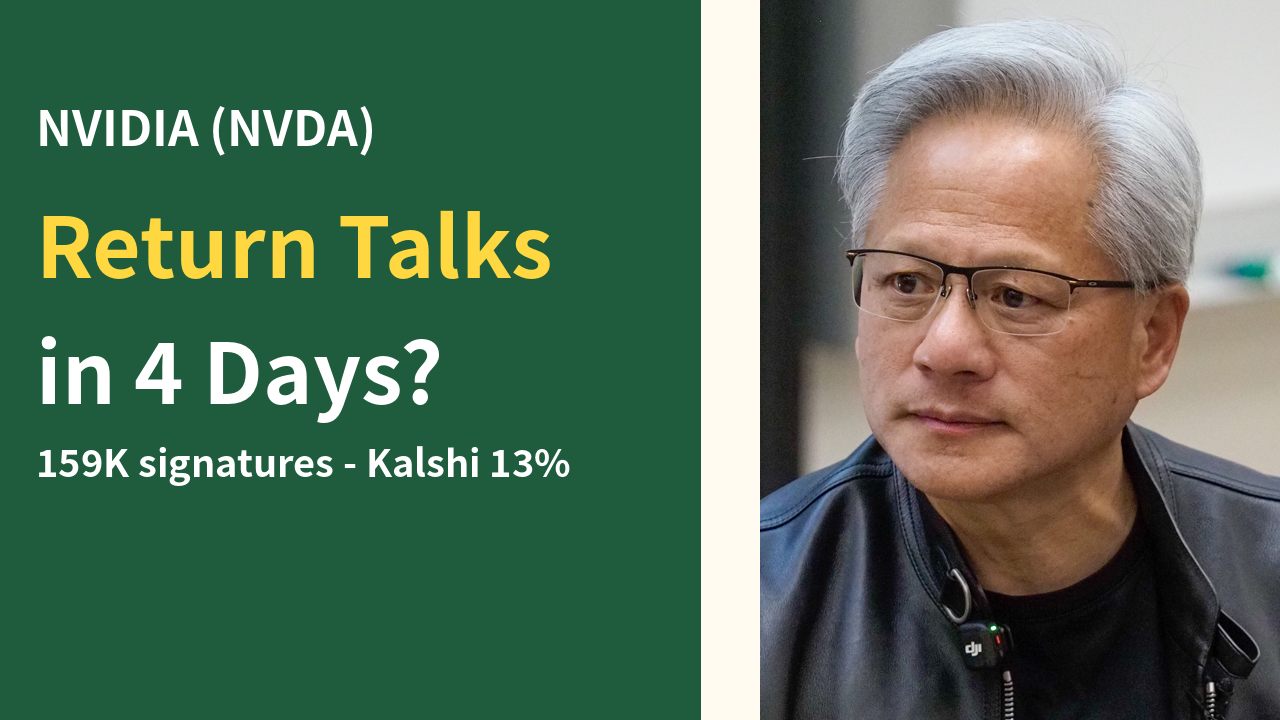
    Four days. That is all it took for the story to flip. NVIDIA founder Jensen Huang resigned as CEO on November 12 — and on November 15, the Financial Times reported that he has discussed returning to the job with close confidants.

    Let us be clear about the conclusion first: a return is, at this stage, a reported discussion — not a decision. NVIDIA’s board has decided nothing, and the search for a permanent successor is running in parallel. Even so, a public petition has passed 159,089 signatures, prediction markets have started pricing the drama, and the company’s first post-resignation earnings report lands on the morning of November 18, Japan time.

    Here is the timeline, the three-way tug of war, the market odds, and what it means for earnings.
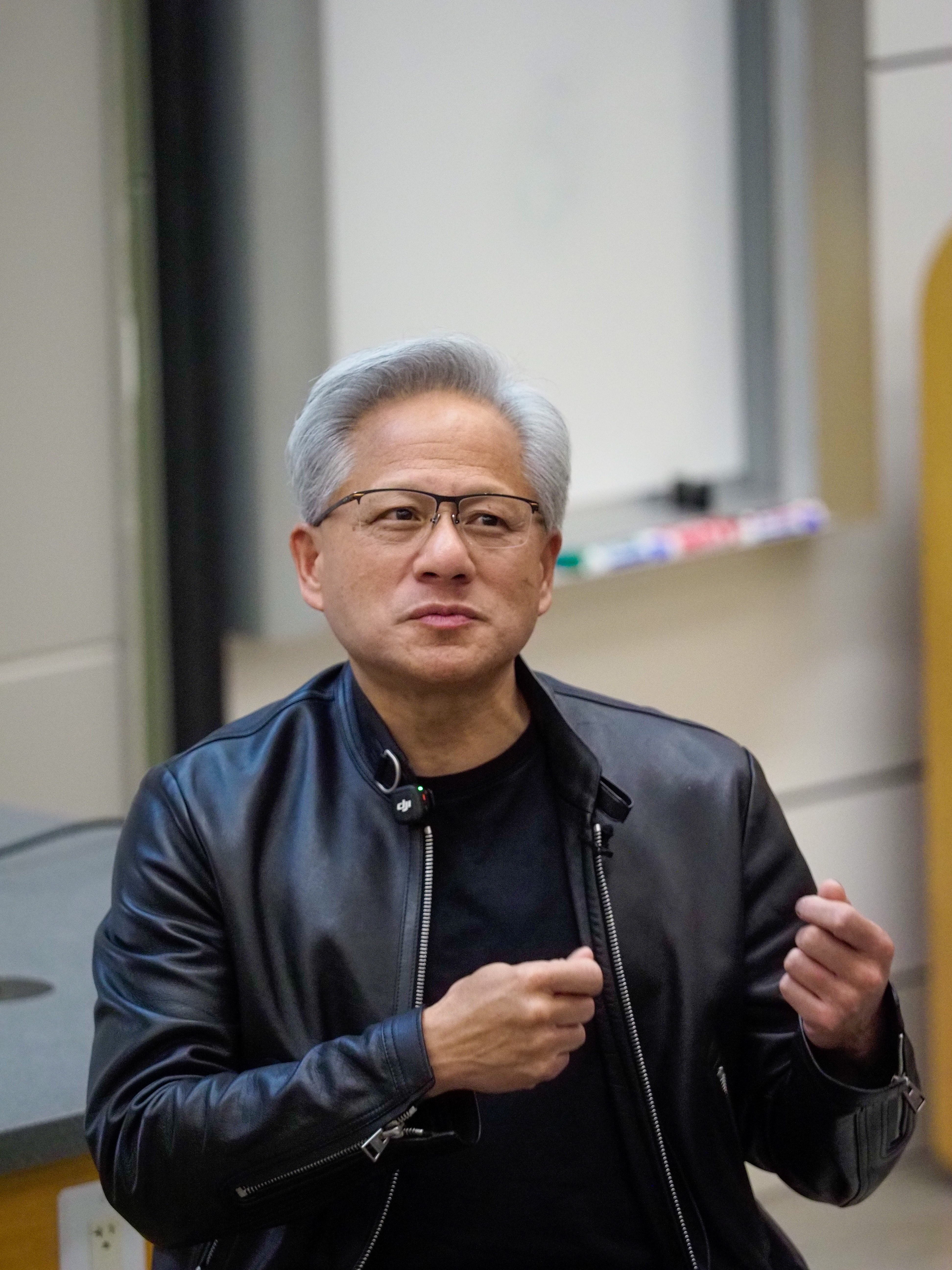
    Jensen Huang

    What was reported

    According to the FT, Huang’s allies are assembling a “war room” of Silicon Valley executives to lobby for his reinstatement, and they hope to win support from the White House as well.

    Meanwhile, the open letter “Stand with Jensen” reached 159,089 signatures by the evening of November 15, by the campaign’s own count. Elon Musk, Epic Games CEO Tim Sweeney, and Y Combinator’s Garry Tan are among the prominent names backing it.

    Two major shareholders have also weighed in. Brad Gerstner of Altimeter Capital and Gavin Baker of Atreides Management published an open letter urging the board to keep “all options on the table, including the potential return of Jensen Huang.”

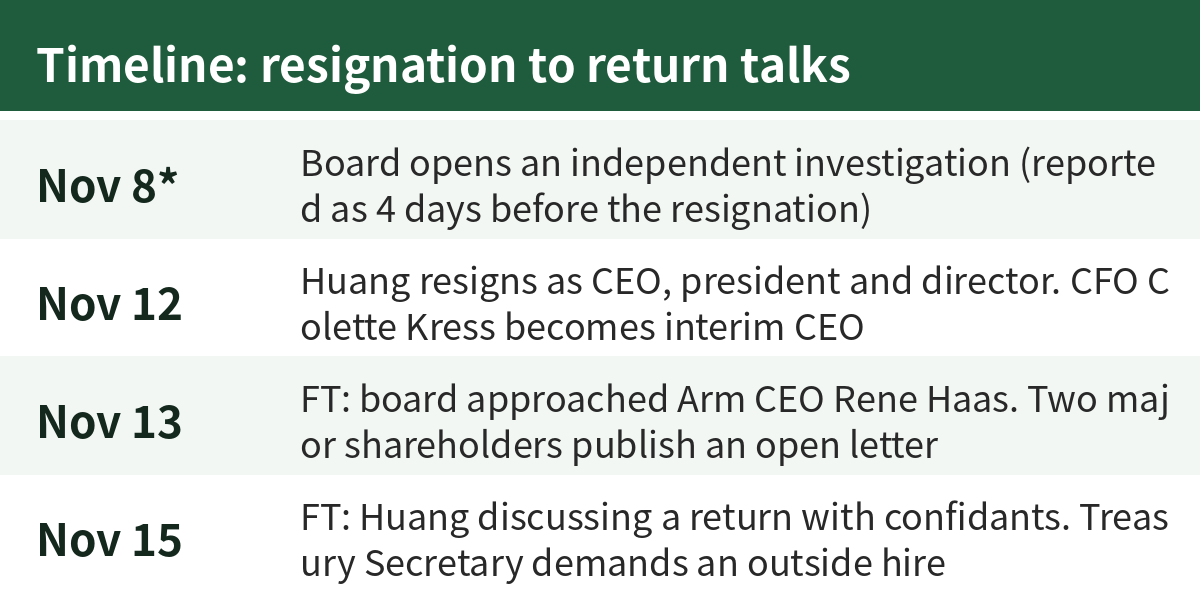
    Timeline: from resignation to return talks
    Timeline
    • Around November 8: The board opens an independent investigation, reportedly following revelations of personal relationships involving Huang
    • November 12: Huang resigns as CEO, president and director, effective immediately. CFO Colette Kress becomes interim CEO; Harvey Jones chairs the board
    • November 13: The FT reports the board has approached Arm CEO Rene Haas as a potential successor (the board denies that a formal process has begun). The two shareholders publish their open letter
    • November 15: The FT reports Huang is discussing a return with confidants. US Treasury Secretary Scott Bessent calls for a “dramatic shake-up” and an outside hire

    The board’s independent investigation into the conduct reports is said to be ongoing, with no conclusion announced. We keep this article to the reported facts.

    A three-way tug of war

    1. The return camp: allies, signatures, shareholders

    The return camp’s assets are people and noise: the allies’ war room, more than 150,000 signatures, and two large shareholders writing in public. Their argument is that Huang, who led NVIDIA for 33 years, personally underpins many of the company’s supply relationships.

    2. The outside camp: the Treasury Secretary and politics

    On the other side, Treasury Secretary Bessent said on November 15 that a “dramatic shake-up” is needed and pressed for an outside CEO. The FT links the political pushback to allegations around advanced chips reaching China. The comeback question has become a governance — and political — fight, not just a corporate one.

    3. The board: the only vote that counts

    Only the board can decide. It has denied starting a formal selection process, has reportedly approached Haas, and is still running its independent investigation. Huang holds no controlling voting stake, so he cannot return on his own say-so. Both the petition and the Treasury Secretary’s comments matter only insofar as they move the board.

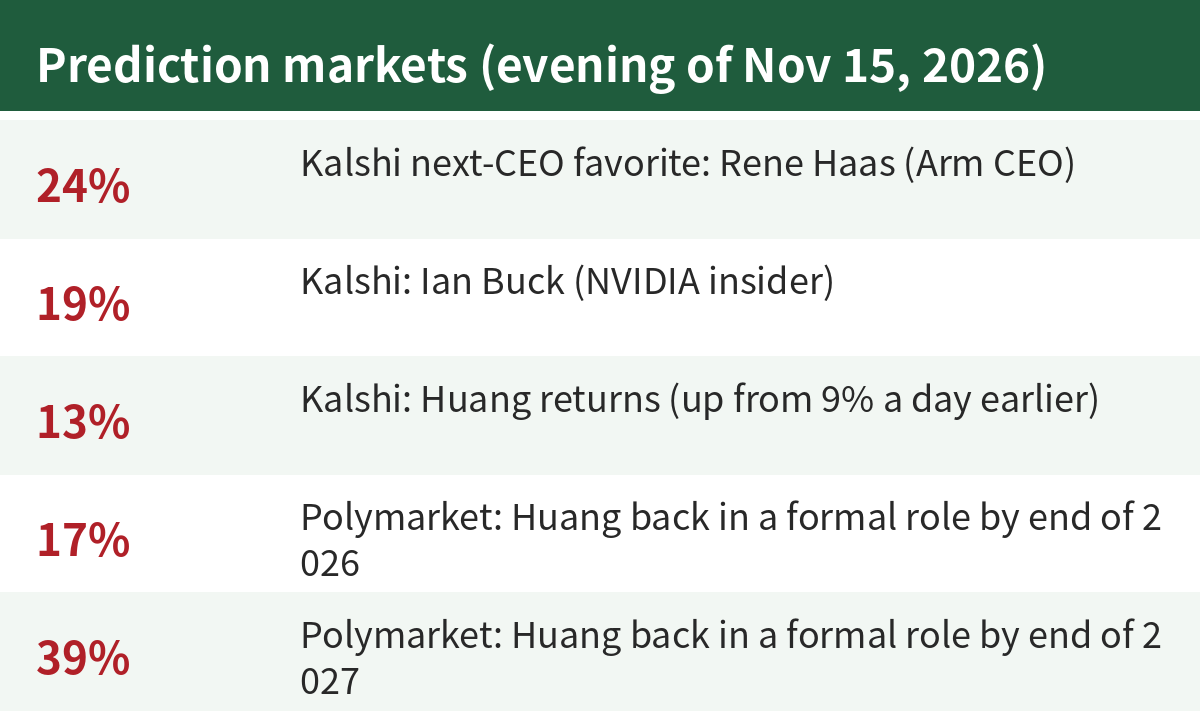
    What prediction markets say
    Prediction market odds
    • Kalshi (evening of November 15): Rene Haas leads the next-CEO market at 24%. NVIDIA’s Ian Buck is at 19%. Huang’s return is priced at 13%, up from 9% the day before
    • Polymarket: a 17% chance that Huang rejoins NVIDIA in a formal role by the end of 2026, and 39% by the end of 2027

    Two things to note. First, Haas — not Huang — remains the favorite. Second, the move from 9% to 13% in a day shows the market’s read is shifting, even if a comeback is still not the base case.

    Earnings on November 18: the first real test

    NVIDIA reports fiscal third-quarter results after the US close on November 17 — the morning of November 18 in Japan. It will be the first earnings release since the resignation, presented by interim CEO Colette Kress.
    NVIDIA headquarters

    The stock closed at $162.85 on November 13, roughly 33% below its 52-week high, after a heavy week of selling. Beyond the numbers themselves — revenue, data center sales, guidance — how far the earnings call goes on the succession question could drive the stock in the short term.

    Our view: more than the return question itself, it is the uncertainty over when and how the board decides that weighs on the shares. If the Kress interim team delivers clean numbers, the “NVIDIA works without Jensen” case gets stronger. Either way, the November 18 earnings are the next fork in this story.

    Summary

    • A Huang return is a reported discussion, not a decision
    • The petition stands at 159,089 signatures (campaign count); Kalshi prices a return at 13%
    • Only the board decides; the Treasury Secretary wants an outsider
    • Earnings on the morning of November 18 (Japan time) are the first test

    We will cover the results as soon as they are out.

    Sources

    • Financial Times (reports of November 13 and 15, 2026); Reuters (November 15, 2026)
    • Signature count: Stand with Jensen campaign tally, evening of November 15, 2026
    • Prediction markets: Kalshi and Polymarket, evening of November 15, 2026
    • Share price: close of November 13, 2026

    Photo credits: Jensen Huang: Anders Eidesvik, CC BY-SA 4.0 / CC BY 4.0, via Wikimedia Commons / NVIDIA headquarters: Coolcaesar, CC BY-SA 4.0, via Wikimedia Commons

    Update: The Shock Spreads to Taiwan’s Market (Nov 16)

    The shock from Jensen Huang’s resignation has hit Taiwan’s market head-on.

    • Taiwan’s TAIEX plunged as much as 1,872.91 points intraday on November 16 — the eighth-largest intraday drop on record — touching an intraday low of 41,802 (source: ETtoday and other Taiwan media).
    • Delta Electronics hit its daily limit down, and Foxconn fell more than 7%.
    • Yang Chin-long, governor of Taiwan’s central bank, told parliament that the resignation is “a turbulence with a major impact” on financial markets. He added that the reasons behind the resignation remain unclear and that the new leadership’s direction needs watching.

    Taiwan is the production heartland of Nvidia’s AI servers and supply chain. The resignation is no longer one company’s personnel story — it is now shaking an entire market.

    What to watch next: Nvidia’s earnings, due early on November 18, Japan time. What the new leadership says about the succession and the supply chain will decide whether this turbulence settles or spreads.

    We also covered this in a breaking Short: https://www.youtube.com/watch?v=lRropFR3aiM

    Update 2: Administration Set to Name Nvidia an AI “National Champion” (Nov 16)

    The shock from CEO Jensen Huang’s resignation has not settled. Nvidia’s market value has fallen from about $5.8 trillion in early October to about $3.9 trillion on Friday — roughly $1.9 trillion gone (LSEG data).

    The fallout has spread to Japan. On November 16, the Nikkei fell more than 1,200 yen at one point, dropping below 60,000. It closed the morning session at 60,182.50, down 959.85 yen (-1.57%). AI and semiconductor stocks led the decline, following a 3.43% drop in the Philadelphia Semiconductor Index (SOX) in the U.S. the previous Friday.

    Then, on the eve of earnings, major policy news arrived. The Trump administration is set to name Nvidia among more than 25 AI “national champions” (WSJ, via Reuters). Amazon, Microsoft, OpenAI and Anthropic are also on the list, and Commerce Secretary Howard Lutnick is expected to announce it within a week. The aim is to get foreign companies and countries to adopt U.S. AI technology over Chinese rivals. The program itself was announced about a year ago, but the companies had never been named until now.

    What Happens Next

    What the designation actually does: The substance is still unclear — whether it means help winning overseas orders, a different treatment on export controls, or financial backing. Until the announcement’s details are known, its effect on the stock cannot be measured. But the message itself is clear: even in the middle of the resignation turmoil, the administration is not cutting Nvidia loose — it is putting the company at the center of national policy.

    What earnings must answer: In the results due early on November 18, Japan time, the focus is whether revenue reaches the roughly $109 billion consensus (LSEG) and whether the bullish outlook for next year holds. What interim CEO Colette Kress says about the succession and the supply chain will also matter.

    Our view: The policy tailwind could offset the “governance discount” from the resignation shock. But while the designation’s substance remains unclear, the earnings numbers come first. The right order is: check the results, then check the policy details.

    We also covered this in a breaking Short: https://www.youtube.com/shorts/al8LvJqqpCQ

    (Sources: WSJ, Reuters, TBS NEWS DIG, LSEG)
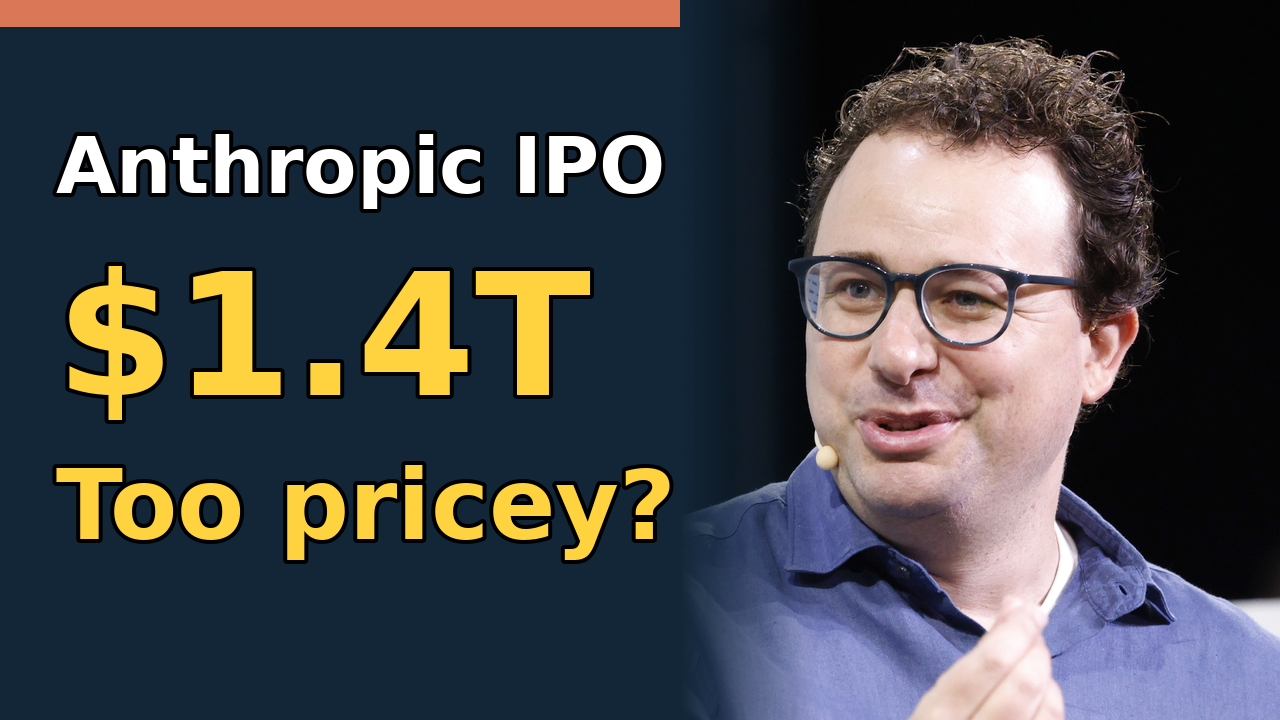
  • Anthropic IPO (ANT): A $1.4 Trillion Debut — But Don’t Chase It on Day One

    Anthropic IPO (ANT): A $1.4 Trillion Debut — But Don’t Chase It on Day One

    Our conclusion first: don’t go all-in on day one

    On November 19, 2026, a company valued at roughly $1.4 trillion on a fully diluted basis is scheduled to list on the Nasdaq. That company is Anthropic, the developer of the AI model Claude. Its IPO is one of the largest ever — a price range of $70 to $78 per share, with some 825 million shares on offer.

    Anthropic is, without question, a remarkable growth company. But a great company and a great price to buy it at are two different things. In our view, this IPO is worth watching closely — but not worth chasing with your full position on the first day.

    Our approach, in short:

    1. Don’t go all-in on day one. At a reported fully diluted valuation of about $1.4 trillion, a great deal of future growth is already priced in.
    2. If you want exposure, build it slowly, in small staged amounts. There will be better moments to add.
    3. The real decision points come later: the first earnings report after listing, and the lock-up expiry. Those are the moments to judge whether the growth story in the S-1 is still holding up.

    This article walks through the filing, number by number, so you can see for yourself why we take that view.

    What is Anthropic?

    Anthropic is the American AI company behind Claude, one of the main rivals to OpenAI’s ChatGPT. It was founded in 2021 by a team that included former OpenAI researchers, and its chief executive is Dario Amodei.

    Dario Amodei, CEO of Anthropic
    Dario Amodei, CEO of Anthropic. Photo: TechCrunch (Kimberly White / Getty Images) / CC BY 2.0, via Wikimedia Commons

    From the beginning, Anthropic has built its brand around AI safety — the idea that AI should be made not only more capable, but also safer and more trustworthy. That positioning matters commercially, because Anthropic’s business is not mainly about consumer chatbots. Its revenue comes largely from two enterprise channels: API access, where companies and developers embed Claude into their own products, and enterprise AI services, where companies pay for Claude to support internal work such as development and analysis.

    In other words, Anthropic is not selling a novelty. It is trying to become part of the infrastructure its corporate customers use every day. The most striking number in the S-1 suggests that shift is already happening — but we will get to that below.

    Anthropic is incorporated as a public benefit corporation (PBC). Its governance is unusual: voting control is concentrated in a Long-Term Benefit Trust and a Founder LLC, a structure the filing itself flags as a risk because it can conflict with ordinary shareholder interests.

    The S-1 numbers: revenue that barely looks real

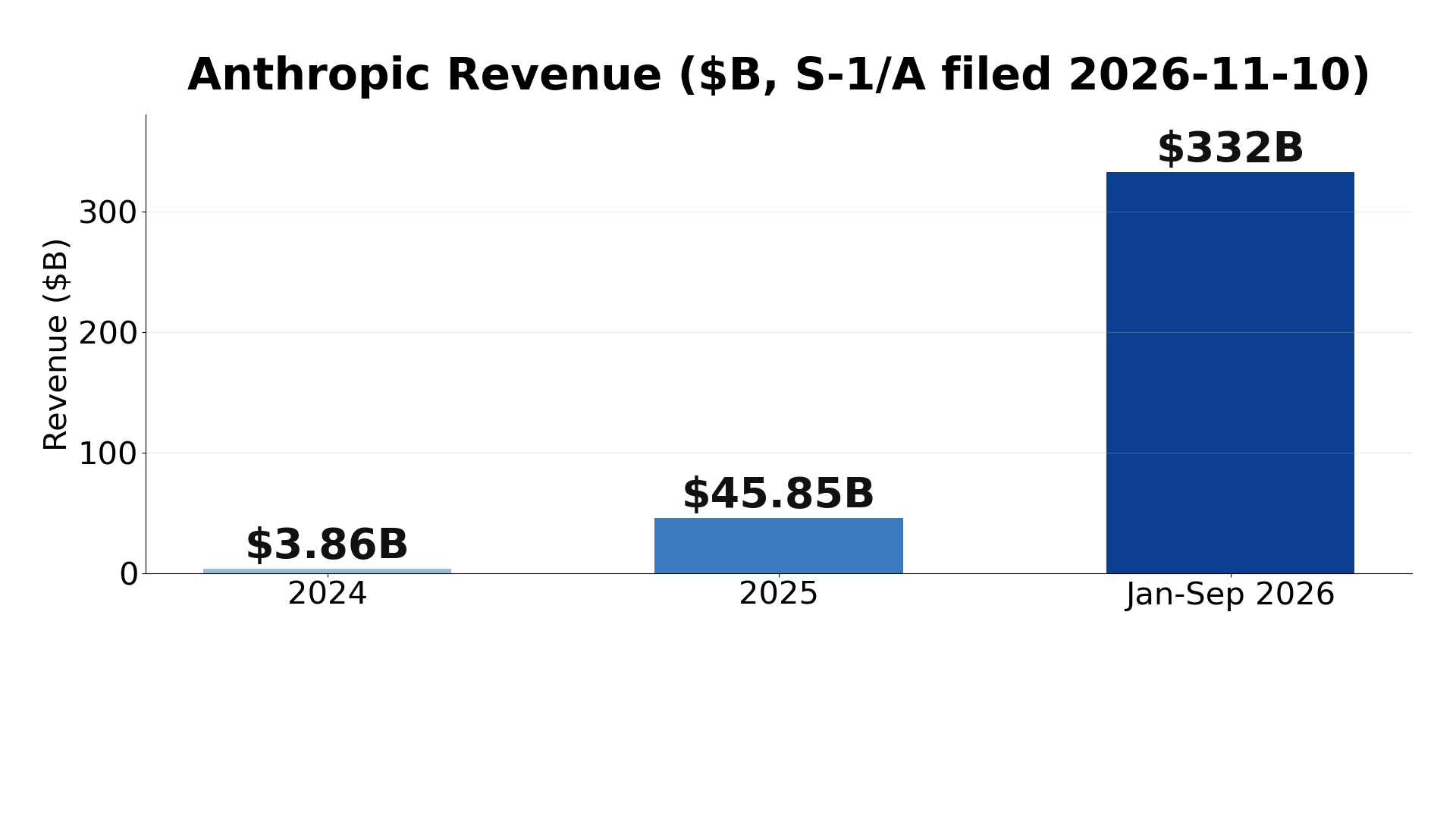
    The revenue growth in the filing is extraordinary by any standard. Anthropic’s annual revenue went from $386 million in 2024 to $4,585 million in 2025 — roughly a 12-fold increase in a single year. And the pace has not slowed: revenue for the first nine months of 2026 was $33,242 million, compared with $2,545 million in the same period of 2025 — about 13 times higher.

    The quarterly detail is just as striking. In the third quarter of 2026 alone (July–September), revenue was $16,956 million, up 1,127% year on year according to the filing, and up 47% from the second quarter’s $11,555 million. And the run-rate — the pace of recent revenue annualised — stood at approximately $81 billion as of October 31, 2026, up $10 billion from September 30.

    PeriodRevenueContext
    2024 (full year)$386 millionBase year
    2025 (full year)$4,585 million~12x year on year
    Jan–Sep 2025$2,545 millionComparison period
    Jan–Sep 2026$33,242 million~13x year on year
    Q2 2026$11,555 million—
    Q3 2026$16,956 million+1,127% year on year; +47% vs Q2
    Run-rate (Oct 31, 2026)~$81 billion+$10 billion from Sep 30
    Anthropic revenue trend

    Source: Anthropic, Form S-1/A, filed November 10, 2026 (SEC EDGAR).

    But revenue is only half the story. For an AI company, the question is always how much compute it costs to earn that revenue. Here the S-1 shows real improvement. Compute costs were 160% of revenue in 2025 ($7,326 million), meaning the company was spending more on compute than it took in. In the first nine months of 2026, that ratio had fallen to 57% ($18,808 million). Spending more efficiently per dollar of revenue is exactly the direction a business like this needs to move in.

    Losses are narrowing too, at the operating level. The third quarter of 2026 produced an operating loss of $567 million — still a loss, but far smaller relative to revenue than before, and the second quarter of 2026 was actually profitable on an operating basis, with $974 million of operating income. The operating loss for the first nine months of 2026 was $1,260 million.

    So why does the same filing show a net loss of $104,039 million for January–September 2026? The answer is accounting, not cash. The main driver was a $94,324 million charge for changes in the fair value of convertible notes, derivative liabilities and SAFEs — a non-cash revaluation driven by the increase in Anthropic’s enterprise valuation. In plain terms, as the company became more valuable, the accounting value of its convertible instruments rose, and that increase was booked as a loss. It is not the same as $104 billion of cash leaving the company. The accumulated deficit stood at $156.2 billion at the end of the period, again largely reflecting these accounting effects.

    There is one more number that captures the strength of the business model: net revenue retention (NRR) was approximately 900% as of September 30, 2026. That means existing customers — specifically, qualified customers measured on a comparable three-month basis, excluding Claude Pro, Max and Ultra subscribers — spent about nine times as much as they did a year earlier. This is not growth from new customers. It is the same companies using Claude far more than before. That is the pattern you would expect if AI is moving from an experiment to an everyday part of corporate work.

    The $900.9 billion commitment — and the strange circle of money

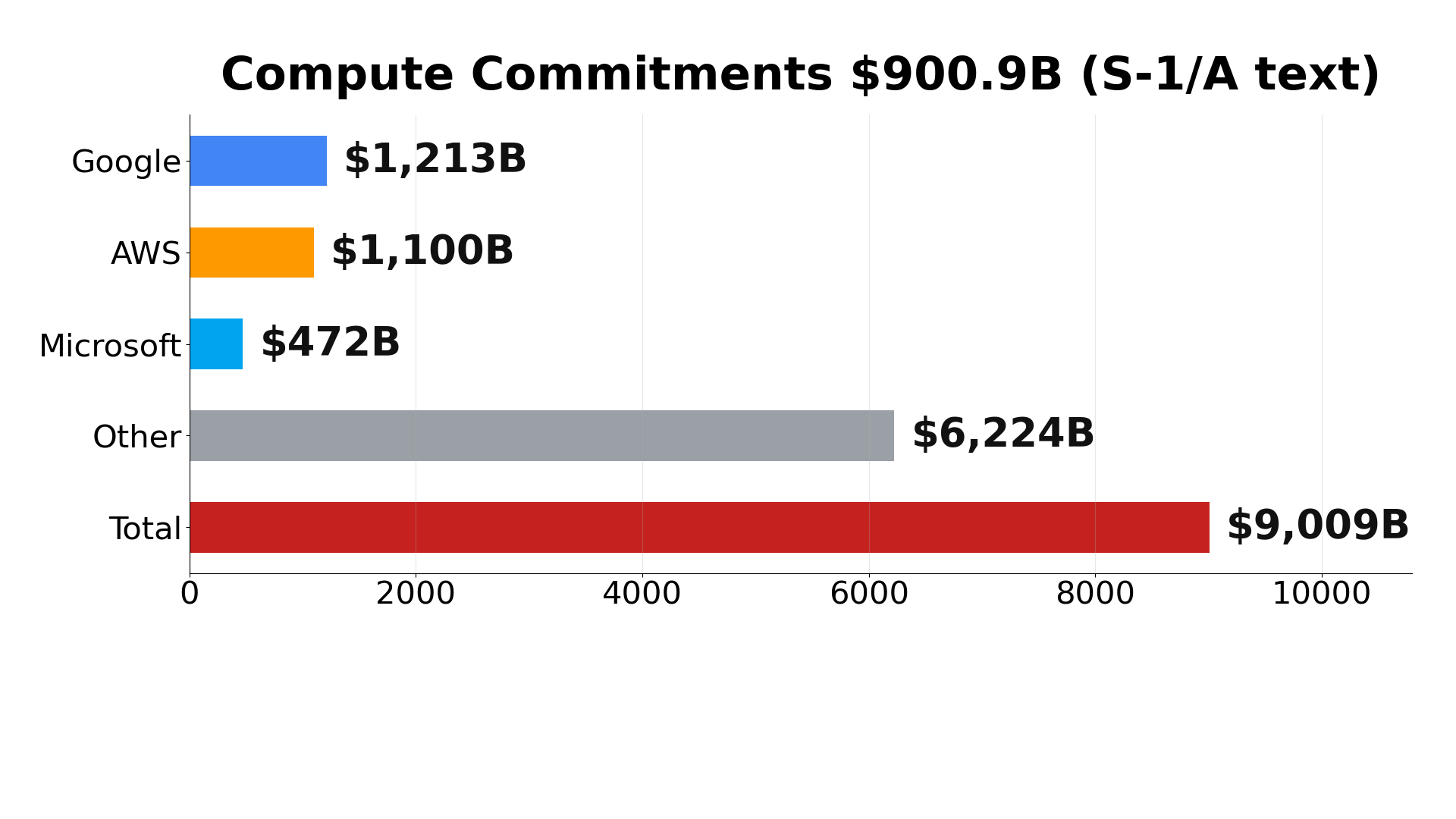
    Now we come to the part of the S-1 that deserves the most attention. Anthropic has committed to an aggregate spend of approximately $900.9 billion on compute and infrastructure — a figure the filing itself discloses, measured as of September 30, 2026 plus contracts signed afterwards. About $451.6 billion of that falls due by the end of 2030, with the rest largely due between 2031 and 2045.

    Even the near term is large: about $70.7 billion is due within 12 months of September 30, 2026, of which roughly $4.2 billion is conditional or cancellable. On top of the $900.9 billion, the filing discloses potential payments of $150 billion to $175 billion under arrangements that do not specify a fixed dollar commitment, and notes that about $186.2 billion of the total is cancellable or subject to conditions precedent.

    The biggest individual commitments show where the money is going:

    CounterpartyCommitmentPeriod
    Microsoft$47.2–49.2 billion (minimum–maximum, take-or-pay)Nov 2026 – Jun 2033
    Google~$121.3 billion (cloud hosting minimum)Apr 2026 – Jul 2033
    Amazon (AWS)$110.0 billion (minimum)May 2026 – Apr 2036
    SpaceXAIUp to $120.5 billionThrough 2029 (cancellable on 90 days’ notice after initial period)
    Broadcom~$161.2 billion (equipment leases, excl. interest)—
    NscaleUp to ~$44.6 billion—
    Lambda~$41.3 billion—
    Anthropic compute commitments by counterparty

    Source: Anthropic, Form S-1/A, filed November 10, 2026 (SEC EDGAR). The three largest named commitments alone total about $278.5 billion.

    That is a huge bill for a company whose nine-month revenue was $33.2 billion. It is also, in our view, the most interesting structural feature of this IPO — because the companies receiving that money are largely the same companies funding Anthropic.

    Alongside the public offering, Anthropic is running a concurrent private placement of $26.0 billion in Class N shares, at the same price as the IPO, to seven companies: Advanced Micro Devices, Broadcom, Google, Micron Technology, Microsoft, NVIDIA and TSMC Partners. Google’s share of that placement is confirmed in the filing at $10.0 billion; the individual amounts of the other six are not disclosed in the S-1. Amazon and Google are also among Anthropic’s largest shareholders: after the offering and the private placement, Amazon is set to hold 1,920,511,218 Class N shares (about 14.7% of total shares outstanding), with a further 1,563,617,444 shares issuable on conversion of notes it holds, and Google is set to hold 1,789,598,269 Class N shares (about 13.7%).

    So the same group of companies is, at once, Anthropic’s investor, its supplier of chips and cloud capacity, and in many cases its customer. Anthropic’s growth creates demand for semiconductors and cloud services; the companies that supply those services invest in Anthropic; and they also use its AI. That is not necessarily a bad thing — it can be read as a vote of confidence from the companies that know this industry best. But it is a deeply interdependent structure, and it cuts both ways: the more Anthropic grows, the more compute it must buy, and the more it depends on keeping these relationships intact.

    Is $1.4 trillion fair? The IPO terms in detail

    The offering itself is mostly new shares, which means the money goes to the company to fund growth rather than to existing shareholders cashing out. The details, from the S-1 cover page:

    • Shares offered: 825,000,000 in total — 801,351,354 new shares from the company and 23,648,646 shares sold by existing shareholders.
    • Price range: $70.00 to $78.00 per share.
    • Overallotment option: a further 123,750,000 shares.
    • Concurrent private placement: $26.0 billion (see above).
    • Net proceeds: approximately $84.6 billion at the $74 midpoint, including the private placement.
    • Ticker: ANT, on the Nasdaq. Lead underwriters are Goldman Sachs and Morgan Stanley. Pricing is expected on November 18 (U.S. time), with listing expected on November 19, according to press reports.
    • Shares outstanding after the offering and placement: 13,086,672,593 across all classes (13,210,422,593 if the overallotment option is fully exercised). At the top of the range, $78, that implies a market capitalisation of roughly $1.02 trillion on an issued-share basis.
    • Fully diluted valuation: about $1.4 trillion, as reported — this figure is not stated directly in the S-1. It reflects the shares that could be issued in future, including about 1.77 billion stock options, 1.13 billion RSUs and convertible-note shares outstanding as of September 30, 2026.

    Set against the run-rate of roughly $81 billion, a fully diluted $1.4 trillion is about 17 times run-rate revenue. That is not an absurd multiple for a company growing this fast — but it is a multiple that assumes the growth continues. Let us look at both sides.

    The bull case. Enterprise adoption of Claude keeps spreading, existing customers keep spending more (remember that roughly 900% net revenue retention), the compute-cost ratio keeps improving from 57%, and operating losses keep shrinking until the company becomes durably profitable. In that world, $1.4 trillion could look reasonable — even cheap — in hindsight.

    The bear case. AI competition intensifies, Claude’s growth slows, and price competition compresses margins. Meanwhile the compute bill does not shrink: the $900.9 billion in commitments has to be paid whether growth continues or not, and take-or-pay contracts with the likes of Microsoft lock in minimum spending. In that world, a 17-times-run-rate valuation would be hard to sustain.

    What do you think? Is $1.4 trillion a fair price for the future of the AI market — or is it pricing in too much growth, too soon? In our view, the business itself has enormous potential — the nine-fold increase in existing customers’ spending and the improvement in compute efficiency are genuinely impressive. But the price carries a large amount of growth expectation already. A good company and a good price to buy it at are different things.

    Should you buy the Anthropic IPO?

    Our conclusion is the one we opened with: don’t go all-in on day one. Three reasons:

    1. The valuation is already high. At a reported fully diluted $1.4 trillion — about 17 times run-rate revenue — a great deal of future growth is already reflected in the price.
    2. The compute commitments are enormous. The $900.9 billion in commitments, with $70.7 billion due within 12 months, is a real liability. We want to see how revenue growth, the compute-cost ratio and operating losses develop before committing serious money.
    3. The first-day price is unpredictable. In a high-profile, large IPO like this one, expectations can push the stock sharply in either direction at the open. There is no need to rush a large amount of money in on the basis of first-day price action alone.

    So what would we do instead? Start small, and buy in stages. If you believe in Anthropic’s growth, take a small initial position and add to it as the evidence accumulates. Two moments matter most:

    • The first earnings report after listing. Is revenue growth continuing? Is the compute-cost ratio improving further? Are operating losses still shrinking? The S-1 story is a snapshot — the first post-IPO results will show whether it is still true.
    • The lock-up expiry. Lock-up restrictions prevent existing shareholders from selling immediately after listing; when they lift, supply and demand for the shares can change. That is not guaranteed to push the price down, but it is a moment worth watching.

    The Anthropic IPO is an important event for anyone following the AI market: revenue is expanding at an extraordinary pace, compute efficiency is improving, and yet the compute commitments are huge and the valuation is about $1.4 trillion on a fully diluted basis. The attractive parts and the cautious parts are both clear. That is why we would rather watch the numbers after listing — and decide step by step — than rush in on day one.

    We will follow up after the November 19 listing with the actual offer price, the first day’s trading, and what it means for the story above. Stay tuned.

    Download the one-page summary PDF (Japanese)

    Read the Japanese version of this article

    Update (November 16): Demand at About Six Times, China and Hong Kong Investors Shut Out

    A pre-pricing update.

    According to Bloomberg and Reuters, both citing people familiar with the matter, orders for Anthropic’s IPO have reached about six times the number of shares on offer. The book was reportedly about two times covered on the first day of the roadshow and built to roughly six times within days. The strength of demand has fuelled talk that the offer could price at the top of the $70–78 range, or above it. Bankers have reportedly told buyers that existing backers will be prioritised, so new investors are unlikely to receive the allocations they asked for.

    The second unusual development: institutional investors in mainland China and Hong Kong are being shut out. Bloomberg reported that several banks handling the deal have either refused orders from those investors or told them allocations are highly unlikely, with the constraints partly due to the US International Traffic in Arms Regulations (ITAR) — a sign that AI is now treated as defence-relevant technology. Note that this concerns IPO allocations; it does not bar anyone from buying the shares in the market after listing. A similar restriction was reported for SpaceX’s IPO earlier this year.

    On the $26 billion concurrent private placement, Nvidia and Google are each reported to be buying about $10 billion. (In the S-1 itself, the only individual amount stated is Google’s $10.0 billion.).

    Pricing is set for November 18, with trading to begin on November 19. How a six-times-covered book translates into the offer price and the first-day pop is the next question. Our view — do not go all-in on day one; if you buy, start small and in tranches — is unchanged. We will follow up with the pricing and the debut.

    The demand multiple, the investor restrictions and the individual private-placement amounts are based on press reports citing people familiar with the matter, not on confirmed disclosures.

    Sources: Bloomberg (November 12–13, 2026, citing people familiar); Reuters (November 12, 2026, citing a person familiar).

    Sources

    • Anthropic, PBC, Form S-1/A (Amendment No. 2), filed November 10, 2026 — SEC EDGAR (CIK 0002130357, accession no. 0001628280-26-072484). All filing figures in this article are taken from this document.
    • Reuters and Bloomberg, November 10–12, 2026 — pricing and listing timetable (November 18 pricing, November 19 listing).
    • BusinessToday, November 11, 2026 — third-quarter operating loss of $567 million, as confirmed against the filing.

    This article is for informational purposes only and does not constitute investment advice. Figures are as disclosed in the S-1/A; the fully diluted market capitalisation of about $1.4 trillion is a reported figure, not a figure stated in the filing.

  • IonQ vs. Rigetti vs. D-Wave: Is IonQ’s Lead Real? Comparing the Three Pure-Play Quantum Computing Stocks

    IonQ vs. Rigetti vs. D-Wave: Is IonQ’s Lead Real? Comparing the Three Pure-Play Quantum Computing Stocks

    Hello, this is Bota Labo.

    Quantum computing has moved beyond university research labs and entered the stage of commercial procurement, with government agencies and global enterprises now placing real orders. At the forefront of this shift are the three listed pure-play quantum computing companies in the United States: IonQ, Rigetti, and D-Wave.

    IonQ has already reported its third-quarter earnings, surprising the market with record-breaking figures. Rigetti and D-Wave are set to report their earnings from tonight through tomorrow morning. Following IonQ’s strong results, shares of both companies rallied ahead of their earnings announcements (Rigetti +19%, D-Wave +18%). However, a sympathy rally is not the same as fundamental strength. This article compares the fundamentals of all three companies and highlights the key figures to watch in their earnings.

    Basic Comparison of the Three Companies

    CompanyTechnologyRevenueBacklogCash on HandEarnings Status
    IonQTrapped-ion$173.83 million (Q3 actual, +336% YoY)More than $1.2 billionApproximately $1.1 billion (as of Q3)Reported
    RigettiSuperconductingQ2 actual: $5.14 million / Q3 estimate: approximately $3.52 millionIncluding the $8.4 million C-DAC contractApproximately $541 million (as of Q2)Reporting tomorrow morning
    D-WaveQuantum annealing + gate modelQ2 actual: $3.08 million / Q3 estimate: approximately $4.34–$4.37 million$40.7 million (+668% YoY)Approximately $546.2 million (as of Q2)Reporting tonight

    Looking at the numbers, IonQ is currently operating on an entirely different scale. However, the three companies use completely different technologies, and the timing of when each can generate revenue also differs.

    Differences in Technology: Strengths and Weaknesses

    IonQ (Trapped-Ion Technology)

    This approach uses lasers to control ions. Its strengths include high two-qubit gate fidelity of 99.99% and all-to-all connectivity, in which every qubit is directly connected to every other qubit. Because the system operates in a room-temperature vacuum environment, it does not require large-scale refrigeration and is easier to install in data centers. On the other hand, gate operations are slower than in superconducting systems, and scaling up faces challenges related to moving ions (shuttling) and optical interconnects. In June 2026, IonQ reported that its new quantum error-correction approach, qLDPC, had pushed error rates past the break-even point, making it possible to create logical qubits with fewer physical qubits.

    Rigetti (Superconducting Technology)

    Rigetti uses superconducting circuits, the same general technology employed by Google and IBM. Gate operations are extremely fast, on the order of nanoseconds, and the approach can leverage semiconductor manufacturing technology. The company operates its own fabrication facility, Fab-1, in California. Its 84-qubit Ankaa-3 system has achieved 99.5% gate fidelity. Its weaknesses include the need for dilution refrigerators to cool the system to temperatures near absolute zero, the very large number of physical qubits required for error correction, and supply risks for helium-3 used in refrigeration.

    D-Wave (Quantum Annealing + Gate Model)

    D-Wave is a pioneer in quantum annealing, an approach specialized in combinatorial optimization problems. Its latest system, Advantage2, features more than 4,400 qubits. One of its major strengths is its extensive track record of real-world production use by large enterprises in logistics and financial optimization. However, quantum annealing cannot perform general-purpose quantum computing. D-Wave therefore entered the gate model through the technology of Quantum Circuits (QCI), which it acquired in January 2026, but this effort lags the other two companies by several years.

    Where the Companies Stand: Major Contracts

    IonQ: Selected for Stage C, the final phase of the Defense Advanced Research Projects Agency (DARPA) Quantum Benchmarking Initiative (program value of up to $300 million). It also has a $25 million system deployment at Florida International University and a $28 million contract to provide optical atomic clocks, giving it a strong pipeline of defense and academic orders. It acquired semiconductor foundry SkyWater for approximately $1.8 billion, bringing manufacturing in-house.

    Rigetti: Selected as a potential recipient of up to $100 million in funding support under the CHIPS Act, subject to conditions. It has an $8.4 million system order from C-DAC, a government-affiliated research institution in India, and sales of its small QPU, Novera, to the U.S. Air Force Research Laboratory, building a track record in hardware sales.

    D-Wave: Its $20 million Advantage2 sale and installation project at Florida Atlantic University is the primary driver of its sharp increase in backlog. It also has a multi-year cloud contract of approximately $10 million with a Fortune 100 company.

    IonQ’s Q3 Results as the Benchmark

    IonQ’s third-quarter results provide a useful benchmark for comparing the three companies. Revenue reached $173.83 million, up 336% year over year. Gross margin was 52.5%, and the company raised its full-year guidance to $505–$515 million. Backlog exceeded $1.2 billion. More details are available in our IonQ earnings analysis article. Net loss was approximately $410 million, which appears substantial. However, much of this figure resulted from non-cash accounting adjustments related to changes in the valuation of warrant liabilities.

    What to Watch in Rigetti’s Earnings

    The market expects revenue of approximately $3.52 million and EPS of -$0.052. The projected revenue is lower than the $5.14 million reported in Q2. This is because Rigetti’s business is subject to revenue fluctuations depending on the timing of large system deliveries. There are three key points to watch.

    1. Progress on the C-DAC Contract

    The company has indicated that revenue from the $8.4 million order is expected to be recognized after installation and acceptance testing in Q4. The most important thing to watch is whether management confirms that the project is progressing as scheduled.

    2. CHIPS Act Funding

    Investors should look for concrete progress on the potential funding support of up to $100 million.

    3. Cash Runway

    Rigetti had approximately $541 million in cash on hand. Its Q2 quarterly net loss was approximately $52.6 million, including non-cash items. While revenue remains relatively small, the key valuation question is how many years the company can continue operating with its existing cash reserves.

    What to Watch in D-Wave’s Earnings

    The market expects revenue of approximately $4.34–$4.37 million and EPS of around -$0.10. Management has indicated that Q3 revenue should be slightly higher than Q2, with the main revenue opportunity coming in Q4. There are three key points to watch.

    1. Converting Backlog into Revenue

    D-Wave’s backlog stands at $40.7 million, up 668% year over year. The key question is how quickly this backlog is being converted into recognized revenue.

    2. Delivery of the Florida Project

    Will installation begin before the end of the year, or will revenue recognition slip into 2027? Expected Q4 revenue is substantial, at approximately $32.37 million. If the Florida project or other Q4 deliveries falter, the full-year outlook could be undermined.

    3. Share Dilution and Cash Management

    D-Wave’s outstanding share count has more than doubled over the past three years. In January 2026, the company also registered an additional equity financing facility of approximately $330 million, so investors should also watch the pace at which equity raises are diluting shareholder value. Put another way, the central question for D-Wave is whether the pace of converting its backlog into revenue can outpace the dilution from equity financing.

    Risks to Keep in Mind

    All three companies share several common risks. First, revenue recognition can lag by several quarters because the process typically follows the sequence of contract, installation, and acceptance. Second, research and development expenses are substantial, and operating cash flow remains negative. Third, non-cash items, such as warrant valuation adjustments, can cause significant fluctuations in GAAP net loss. As a basic rule, investors should evaluate three figures together when reviewing earnings: revenue, backlog, and cash on hand.

    Summary: The Checklist

    What will determine the share price reactions is not simply the Q3 numbers themselves, but whether the companies maintain or revise their Q4 outlooks. Both Rigetti’s C-DAC project and D-Wave’s Florida project have revenue recognition concentrated around Q4 acceptance and delivery, so judging them on Q3 figures alone would be misleading.

    • IonQ: Can it maintain its lead, backed by a backlog exceeding $1.2 billion?
    • Rigetti: Can it exceed expectations through the C-DAC contract ($8.4 million) and CHIPS Act funding support (up to $100 million)?
    • D-Wave: Can it demonstrate a clear path to converting its $40.7 million backlog and Florida project ($20 million) into Q4 revenue?
  • CoreWeave (CRWV) Q3 Earnings: $3.66B Revenue Beats Estimates, Interest Costs Come in Low, Full-Year Guidance Raised

    CoreWeave (CRWV) Q3 Earnings: $3.66B Revenue Beats Estimates, Interest Costs Come in Low, Full-Year Guidance Raised

    Hello, this is Bota Labo.

    CoreWeave (ticker: CRWV), a leading AI infrastructure-focused cloud provider (neocloud), has reported its third-quarter results.

    The key question was not revenue, but how the company would address its financial structure, in which interest expense was three times operating income. The bottom line: both revenue and adjusted operating income exceeded company guidance, while interest expense came in below even the low end of guidance. Full-year guidance was also raised. The stock rose about 2.5% in after-hours trading, an initially positive reaction.

    Q3 Results: Key Figures

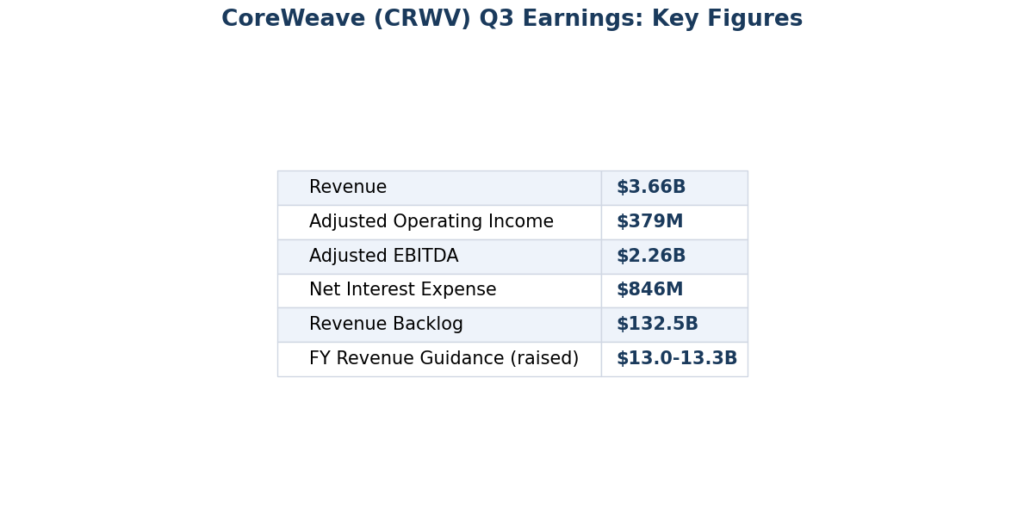
    CoreWeave Q3 earnings key figures
    • Revenue: $3.661 billion (approximately 2.7 times the $1.365 billion reported in the same quarter last year), above market expectations of approximately $3.54 billion–$3.56 billion
    • GAAP Operating Income: $207 million (6% margin)
    • Adjusted Operating Income: $379 million (10% margin). Company guidance was $200 million–$260 million, making this a substantial beat
    • Net Interest Expense: $846 million, below even the low end of the guidance range of $860 million–$940 million
    • GAAP Net Loss: $709 million / Diluted EPS: -$1.27 (a smaller loss than the market estimate of -$1.46)
    • Adjusted EBITDA: $2.256 billion (62% margin)
    • Backlog: Approximately $132.5 billion
    • Capital Expenditures (Q3 actual): $9.441 billion
    • Power in Operation: More than 1.7 GW (over 200 MW added during the quarter). The year-end target of more than 1.85 GW remains unchanged. Contracted power exceeds 4.6 GW

    Full-Year Guidance Raised

    • Full-Year Revenue: $13.0 billion–$13.3 billion (previously $12.4 billion–$13.2 billion)
    • Full-Year Adjusted Operating Income: $1.275 billion–$1.375 billion
    • Full-Year Capital Expenditures: $37.0 billion–$39.0 billion (the lower end was raised from the previous range of $35.0 billion–$39.0 billion, as deployment and delivery to customers were brought forward)
    • Exit ARR at Year-End (Annualized Revenue): Raised to $20.0 billion–$21.0 billion
    • Q4 Net Interest Expense Guidance: $1.05 billion–$1.15 billion

    This is where investors should pay attention. Q4 interest expense is expected to increase further from $846 million in Q3, and the structure in which interest expense far exceeds operating income has not yet been resolved.

    Why the Stock Fell Approximately 49% in One Month Before Earnings

    • Political Risk in Texas: Approximately 40% of the company’s new data center capacity is concentrated in Texas. Gina Hinojosa, who won the gubernatorial election held on November 4, has pledged a moratorium on new data center construction.
    • A Yellow Card from the Bond Market: The company’s bonds maturing in 2031 and 2032 fell to 79–80 cents on the dollar, with yields around 16%. CDS spreads also exceeded 1,100 bps.
    • Sales by the Founder and Major Shareholders: Following the expiration of the lockup period, the three co-founders collectively monetized more than $2 billion through planned sales, and Magnetar, formerly the largest shareholder, also significantly reduced its holdings.
    • Concerns Across the Industry: On October 14, Gartner issued a forecast stating that more than 80% of neocloud providers would abandon independent operations by 2030.

    Checking the Key Questions Against the Results

    • Interest Expense vs. Operating Income: Interest expense of $846 million came in below the lower end of guidance, while adjusted operating income of $379 million substantially exceeded the upper end of guidance. However, the Q4 interest expense outlook of $1.05 billion–$1.15 billion will be the next major headwind.
    • Power in Operation: Exceeded 1.7 GW, with the year-end target of more than 1.85 GW maintained.
    • Backlog: Increased to approximately $132.5 billion.
    • Financing: Raising the lower end of full-year capital expenditure guidance signals the company’s intention to accelerate investment. However, as funding requirements continue to grow, dilution and interest costs will remain important factors to monitor.

    Who Are the Customers?

    The main revenue drivers are Microsoft, OpenAI (with cumulative contracts worth approximately $22.4 billion), and Meta (approximately $14.2 billion).

    Customer and geographic diversification is also progressing, with partnerships including autonomous driving company Wayve, announced on November 9, and India’s Adani Group.

    Conclusion

    CoreWeave’s Q3 results demonstrated that demand is holding up strongly in a business where the central dynamic remains: AI demand is real, but interest costs are the enemy.

    Revenue, operating income, backlog, and full-year guidance were all positive developments. On the other hand, the financial burden remains unchanged, with Q4 interest expense expected to rise into the $1 billion range.

    The next key questions are whether Q4 interest expense stays within the upper guidance limit of $1.15 billion, whether the new Texas administration actually moves forward with a moratorium, and whether accelerated capital investment translates directly into the fulfillment of the company’s backlog.

    Source: CoreWeave, “CoreWeave Reports Strong Third Quarter 2026 Results” (November 10, 2026, investor relations release)

    Disclaimer

    This article is for informational purposes only and does not constitute a recommendation to buy or sell any particular stock. All investment decisions are the sole responsibility of the individual investor. Figures reflect the information available at the time of publication.

  • IonQ’s CFO & COO Steps Down Effective Immediately: Why Did Arm’s Star Finance Chief Leave After 14 Months?

    IonQ’s CFO & COO Steps Down Effective Immediately: Why Did Arm’s Star Finance Chief Leave After 14 Months?

    Hello, this is Bota Labo.

    Something unusual has happened at quantum computing company IonQ. Inder M. Singh, the company’s Chief Financial Officer (CFO) and Chief Operating Officer (COO), has stepped down effective immediately.

    The announcement came before the U.S. market opened on Friday, November 13. What’s more, less than 10 days had passed since Singh himself presented the company’s record-breaking earnings results.

    The bottom line: Looking only at the new leadership lineup, this appears to be a strengthening of the management structure. But the lack of transparency surrounding Singh’s departure has raised questions in the market.

    IonQ shares closed at $28.88 on the day of the announcement, down 6.42% from the previous close. However, the previous day’s 9.40% decline and analysts’ price target cuts need to be considered separately from this management change.

    In this article, we’ll examine who Singh was, who will replace him, and how investors should interpret the implications.

    What Happened: He Was Gone Five Days After Presenting Earnings

    First, let’s look at the timeline (all dates and times are U.S. time).

    • November 5: IonQ announced its Q3 results. Revenue reached a record $173.83 million, up 336% year over year. Singh personally led the earnings presentation.
    • November 10: Singh stepped down (the date recorded in the SEC-filed Form 8-K). This was not publicly disclosed at the time.
    • November 13, 8:30 a.m. (Eastern Time): The company formally announced the executive transition. On the same day, it also filed a prospectus supplement registering 34,580,646 shares for resale.
    • December 3 (scheduled): Gary Merrill is expected to take over as CFO.

    There are three important points.

    First, the departure was effective immediately. When his predecessor left, the transition arrangements allowed that executive to remain as an advisor for up to 60 days. There is no such provision mentioned this time.

    Second, no reason for Singh’s departure has been disclosed. The announcement contains only a comment from CEO de Masi expressing gratitude and wishing him success in his future endeavors.

    Third, while a successor for the CFO position has been named, no replacement for the COO role has been announced. The company has not explained who will assume the operational responsibilities previously handled by Singh.

    IonQ headquarters in College Park, Maryland
    IonQ headquarters in College Park, Maryland. Photo: Blacktupelo / CC BY-SA 4.0 (Wikimedia Commons)

    Who Was Singh? The Finance Heavyweight Behind Arm’s IPO

    Singh is a veteran finance executive with more than 30 years of experience in finance and corporate strategy.

    Inder M. Singh
    Inder M. Singh. Photo: Business Wire

    His career includes serving as EVP and CFO of Arm, the major British semiconductor design company, from April 2019 to December 2022. He handled much of the preparation for Arm’s IPO, which became the largest IPO of 2023.

    Before that, he served as CFO of Unisys and held senior positions overseeing financial strategy and M&A at Cisco. Earlier in his career, he also worked as an equity analyst on Wall Street. In other words, he has viewed corporate finances from both sides of the table: the capital markets and corporate management.

    His relationship with IonQ goes back several years. He joined the company’s board of directors as a member of the audit committee in December 2021 and later served as Lead Independent Director. In other words, he was one of the central figures overseeing the company’s management.

    On September 4, 2025, Singh stepped down from the board and took on the roles of CFO and COO himself.

    His compensation package upon joining was substantial. It included a base salary of $500,000, RSUs worth $6.75 million, performance-based RSUs with a target value of $18 million, and additional compensation to make up for incentives forfeited at his previous employer.

    There is little doubt that he was brought in with considerable fanfare.

    During his approximately 14 months in the role, IonQ underwent major changes.

    The company acquired SkyWater (approximately $1.8 billion in total, with completion in July 2026) and Elisity (completed on November 3, 2026). In October 2026, Singh also led a $2 billion public offering as CFO, bringing the company’s cash and investments to approximately $3.7 billion.

    Since December 2024, IonQ has completed 12 acquisitions totaling approximately $6.2 billion.

    The finance executive responsible for this aggressive expansion strategy had already left just five days after presenting the company’s best-ever earnings results.

    That is the central issue here.

    New CFO Merrill and the New Management Structure: Two Veterans in Finance and Accounting Join at Once

    IonQ’s new CFO will be Gary Merrill, the current CFO of Commvault, a major data protection company. He is scheduled to take office on December 3.

    Merrill has spent more than 20 years at Commvault, including 15 years in its finance organization.

    During his tenure as CFO from 2022 to 2024, he led a transformation of the finance organization and the company’s transition to a subscription/SaaS model. He subsequently served as Chief Commercial Officer, overseeing sales and partner organizations and supporting double-digit ARR growth.

    He had only recently returned to the CFO role in April 2026. Merrill brings experience at a mature publicly listed company with revenue on the scale of $1 billion, having worked in both finance and sales.

    Incoming CFO Gary Merrill
    Incoming CFO Gary Merrill. Photo: Commvault

    CEO de Masi cited Merrill’s experience as a public company CFO and his deep knowledge of cybersecurity as the reasons for his appointment.

    Merrill himself commented that “IonQ’s strong balance sheet is a clear competitive advantage in the quantum industry.”

    At the same time, Thomas A. Austin was appointed effective immediately to the newly created position of Chief Accounting Officer (CAO).

    Austin spent six years as CAO at Juniper Networks and is an accounting specialist who has overseen internal controls and SEC reporting.

    One additional point worth noting: for the approximately three weeks until Merrill takes office on December 3, Chairman and CEO de Masi will also serve as interim CFO.

    This means there will be a transition period during which the CEO holds three roles simultaneously.

    CEO Niccolo de Masi
    CEO Niccolo de Masi. Photo: Isabella1517 / Wikimedia Commons, CC BY-SA 4.0

    Separating the Impact: Share Price, Analysts, and Resale Registration

    Let’s now distinguish between developments directly related to the executive transition and those that are not.

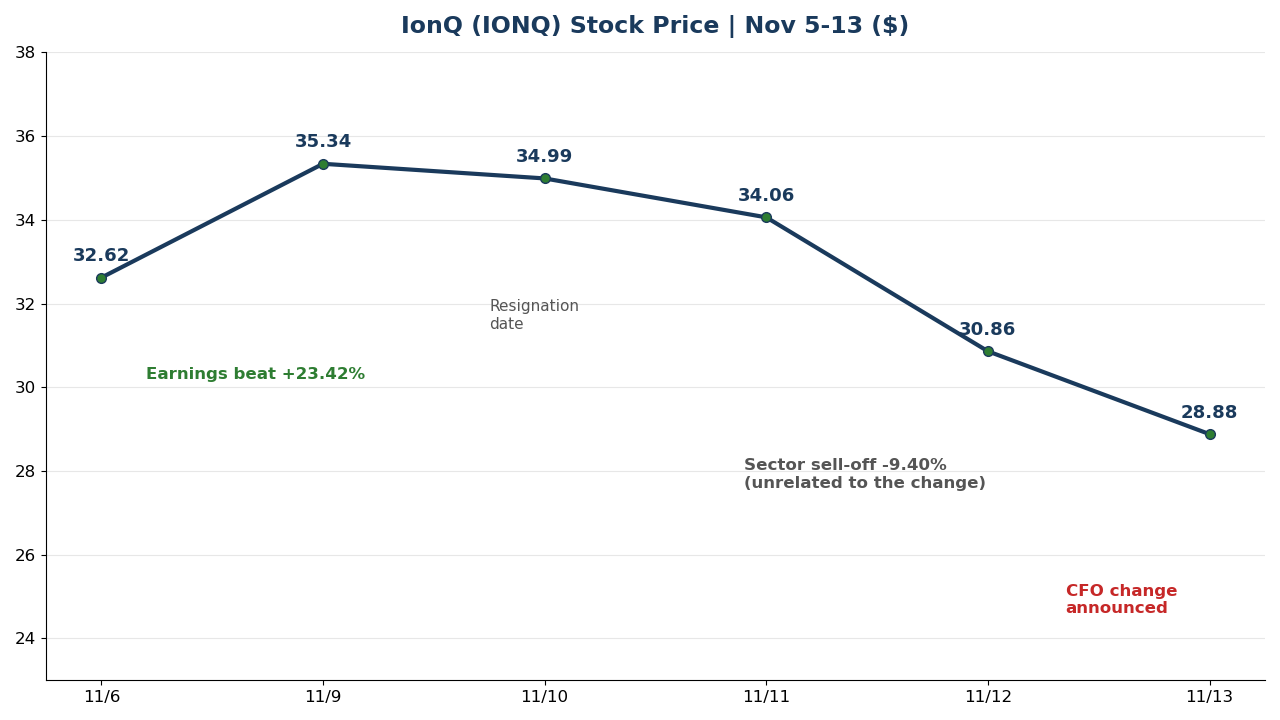
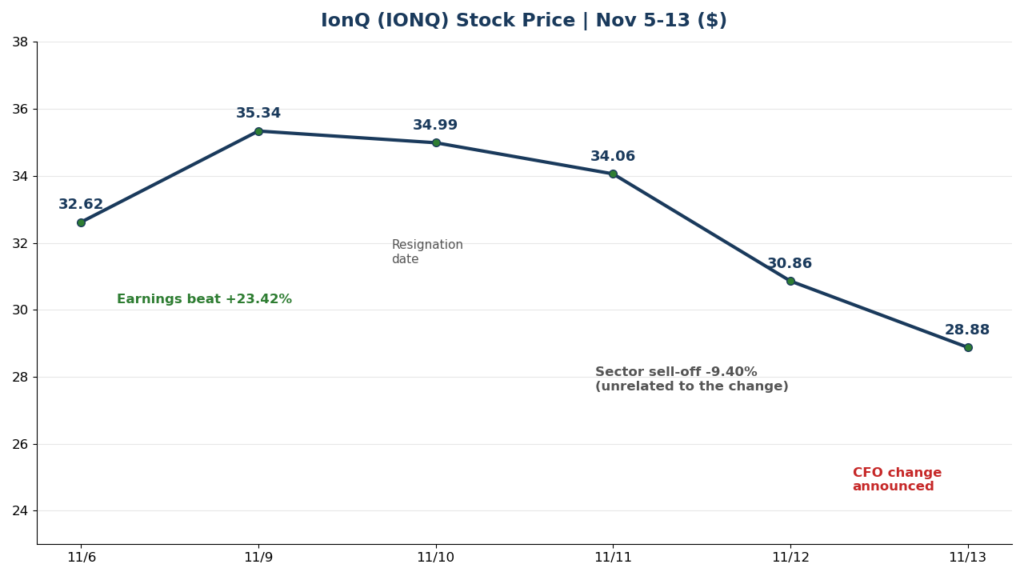
    Share Price: Down 6.42% on Announcement Day. The Previous Day’s 9.40% Drop Was Unrelated

    IonQ (IONQ) share price, Nov 5-13
    IonQ (IONQ) share price, Nov 5-13

    The 9.40% decline on November 12 was unrelated to the management change.

    That day, October CPI came in above expectations, and the U.S. 10-year Treasury yield surged into the 5% range. These developments coincided with management turmoil at Nvidia and earnings misses from Rigetti and D-Wave, triggering a broad sell-off across quantum computing stocks.

    At that point, IonQ’s executive transition had not yet been publicly announced.

    On November 13, the day the transition was announced, IonQ shares fell 6.42%.

    The stock briefly fell more than 8% intraday, but trading volume was 21.58 million shares, approximately 12% below average. This suggests that the decline was driven more by cautious selling and uncertainty than by panic-driven dumping.

    Some overseas media outlets have reported the decline as “7%,” but that is a rounded figure. The confirmed closing-price decline was 6.42%.

    Analysts: Price Target Cuts Came Before the Executive Change

    The narrative that “analysts rushed to cut their price targets in response to the executive transition” gets the sequence wrong.

    Almost all the price target reductions we could confirm occurred around November 6, immediately after the Q3 earnings announcement and before the management change was made public.

    The reason was not the personnel change, but a decline in valuation multiples across the quantum sector as a whole.

    BofA is a particularly telling example.

    The firm raised its revenue forecasts for IonQ to $510 million in 2026, $950 million in 2027, and $1.5 billion in 2028. However, it lowered its valuation multiple, resulting in a reduced price target.

    All the firms maintained their “Buy” ratings. As of the morning of November 14, we could not confirm any new analyst downgrades following the executive transition announcement.

    Resale Registration: The 34.58 Million Shares Have Simply Become Eligible for Sale

    On the same day as the executive transition announcement, IonQ also filed a resale registration covering 34,580,646 shares held by existing shareholders.

    This is not a fundraising procedure through which the company issues new shares to raise capital. Rather, it allows existing holders to sell their shares in the market. IonQ itself receives no cash from these sales.

    To put the size into perspective, 34,580,646 shares represent approximately 8% of the company’s total outstanding shares (approximately 429 million).

    In dollar terms, overseas media outlets reported a value of approximately $1.15 billion, based on an estimated share price of approximately $33.

    Using IonQ’s November 13 closing price of $28.88, the value comes to approximately $1 billion.

    Filing a prospectus does not mean the shares will immediately be sold. Nevertheless, the fact that these shares have become eligible for sale at any time creates a potential supply overhang that investors are likely to watch.

    The following breakdown is speculative.

    IonQ’s acquisition of Elisity, completed on November 3, was entirely stock-based, with 32,233,274 shares issued as consideration.

    That figure is close to the number of shares covered by the latest registration. Since acquisition consideration shares typically come with rights to have them registered for resale, it is highly likely that the registration is closely related to the Elisity acquisition.

    However, we have not been able to confirm the breakdown of the approximately 2.35 million-share difference.

    Two Sides of the Story: Strengthening the Organization or a Sign of Trouble?

    Based on everything discussed so far, there are two ways to interpret this development.

    The Case for a Stronger Management Structure

    The company has positioned the personnel changes as part of its efforts to support “continued growth and a path toward profitability.”

    Both incoming executives are experienced veterans of finance and accounting at publicly listed companies. The creation of a new CAO position also points toward an expansion of the management structure.

    The fact that a sitting CFO at an established public company was willing to move to IonQ could itself be interpreted as a sign of confidence in the company’s future.

    IonQ’s financial position is strong, with approximately $3.7 billion in cash and investments and $1.2 billion in remaining performance obligations (backlog).

    This is not a management change driven by immediate funding pressure.

    Most analysts continue to maintain “Buy” ratings even after lowering their price targets (as of November 6).

    The Case for Concern: Unusual Circumstances and a Lack of Transparency

    Tickeron summarized the situation by noting that “the sudden departure of the finance chief just weeks after record earnings and a major capital raise raises questions about reporting, controls, and strategy that the announcement does not answer.”

    Invezz pointed out that “financial leadership uncertainty has been added at precisely the time when disciplined spending and acquisition integration are needed.”

    To summarize the reasons for concern, there are six points:

    1. No explanation whatsoever has been provided for Singh’s departure.
    2. There is a three-day gap between his departure date (November 10) and the public announcement (November 13).
    3. An executive who was recruited from the board with a substantial compensation package has left after just 14 months.
    4. The CFO position will remain vacant for approximately three weeks immediately before the year-end financial results, with the CEO holding three positions simultaneously.
    5. No successor to the COO position has been announced.
    6. A resale registration covering approximately $1 billion worth of shares was filed on the same day.

    Our Assessment and What to Watch Next

    Here is how we assess the situation at this point.

    Looking only at the new management lineup, this is a strengthening of the organization. However, the lack of an explanation for the circumstances surrounding Singh’s departure has led the market to discount the stock accordingly.

    At the same time, the underlying business figures have not deteriorated.

    Q3 revenue was up 336% year over year. The full-year revenue guidance was raised to $505 million-$515 million, and the backlog stands at $1.2 billion.

    Regarding the integration of SkyWater, the head of foundry operations remains in place. There have been no disclosures or reports indicating that integration is falling behind schedule.

    We believe the main challenge is less about the day-to-day operation of the factories themselves and more about the burden on the teams responsible for producing the financial numbers: acquisition accounting, consolidated financial reporting, and internal controls, particularly given the goodwill balance that has grown to approximately $3.2 billion.

    That is precisely why the decision to bring in both an executive experienced in financial organization reform and an accounting specialist at the same time makes sense as part of a coherent strategy.

    There are four key things to watch next.

    1. Merrill’s appointment on December 3 and any additional disclosures around that time, including Singh’s departure terms and Merrill’s compensation package.
    2. Whether IonQ announces a successor to the COO position.
    3. Whether the company maintains its full-year guidance in its Q4 and full-year results, scheduled for late February 2027, and how the new management team explains its strategy.
    4. Whether analysts make any new rating or price target changes in response to the executive transition announcement.

    The central question – “Why was the departure effective immediately?” – will remain unanswered until the company provides further disclosures.

    Rather than filling the gaps with speculation, we believe the right approach is to monitor the next disclosures and evaluate the situation based on what the company actually reveals.

    Disclaimer: This article is intended for informational purposes only and does not constitute a recommendation to buy or sell any specific securities. All investment decisions are your own responsibility.