Hello from Bota Labo.
Four days. That is all it took for the story to flip. NVIDIA founder Jensen Huang resigned as CEO on November 12 — and on November 15, the Financial Times reported that he has discussed returning to the job with close confidants.
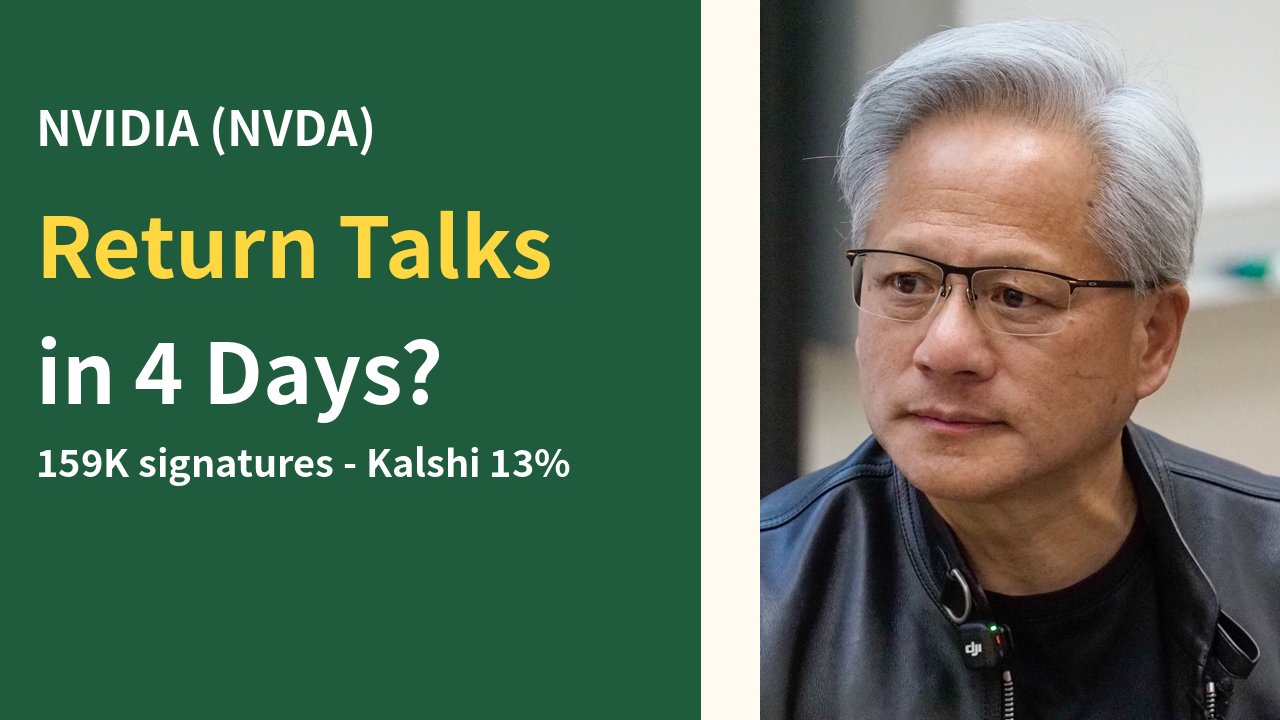
Let us be clear about the conclusion first: a return is, at this stage, a reported discussion — not a decision. NVIDIA’s board has decided nothing, and the search for a permanent successor is running in parallel. Even so, a public petition has passed 159,089 signatures, prediction markets have started pricing the drama, and the company’s first post-resignation earnings report lands on the morning of November 18, Japan time.
Here is the timeline, the three-way tug of war, the market odds, and what it means for earnings.
What was reported
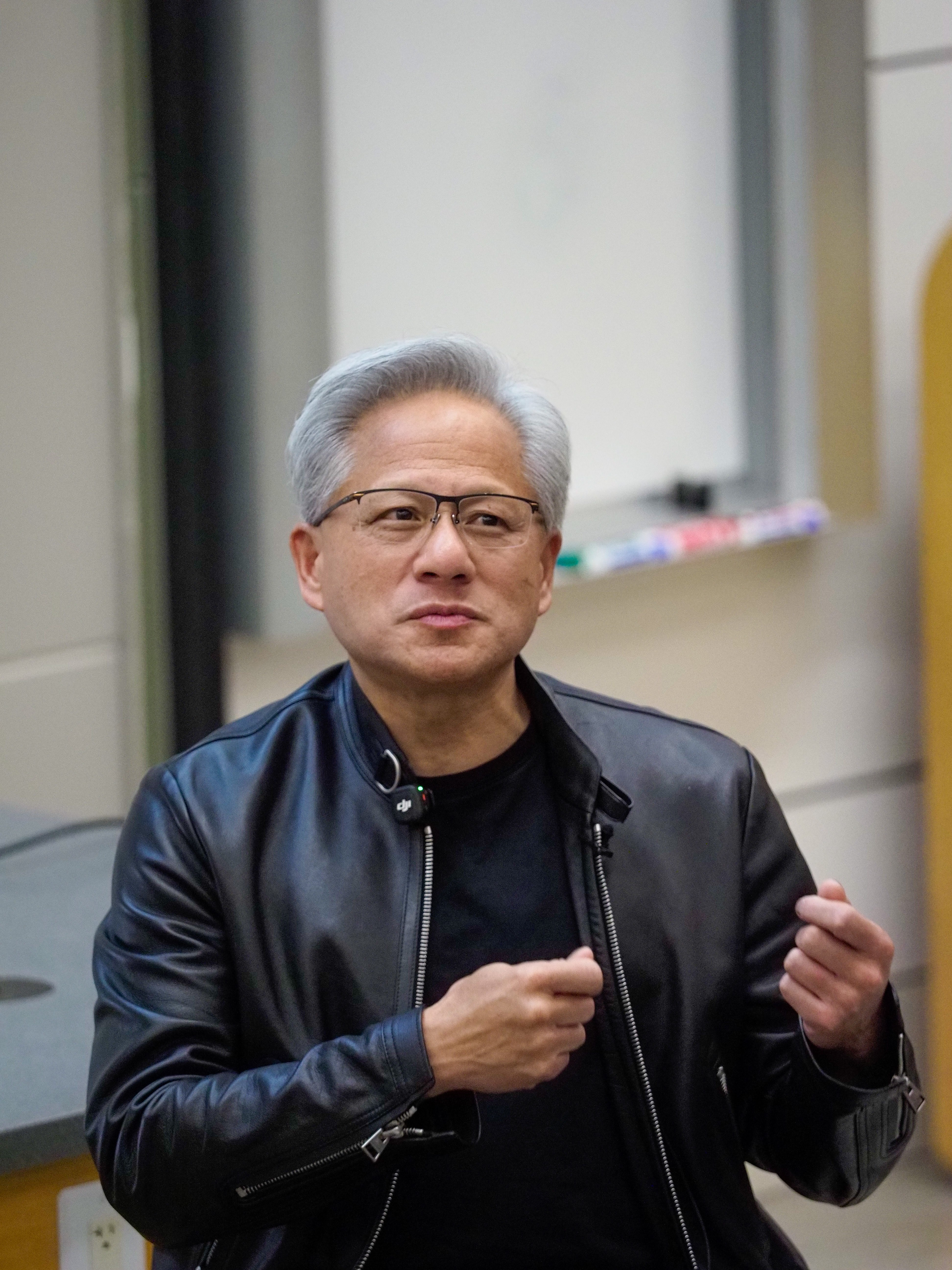
According to the FT, Huang’s allies are assembling a “war room” of Silicon Valley executives to lobby for his reinstatement, and they hope to win support from the White House as well.
Meanwhile, the open letter “Stand with Jensen” reached 159,089 signatures by the evening of November 15, by the campaign’s own count. Elon Musk, Epic Games CEO Tim Sweeney, and Y Combinator’s Garry Tan are among the prominent names backing it.
Two major shareholders have also weighed in. Brad Gerstner of Altimeter Capital and Gavin Baker of Atreides Management published an open letter urging the board to keep “all options on the table, including the potential return of Jensen Huang.”
Timeline: from resignation to return talks
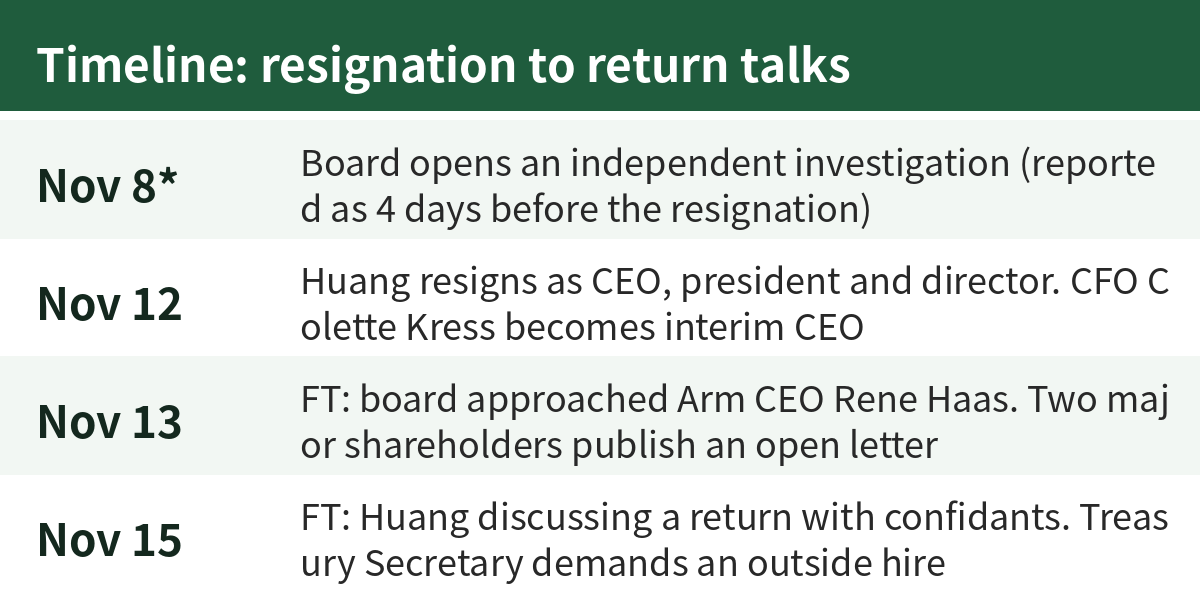
- Around November 8: The board opens an independent investigation, reportedly following revelations of personal relationships involving Huang
- November 12: Huang resigns as CEO, president and director, effective immediately. CFO Colette Kress becomes interim CEO; Harvey Jones chairs the board
- November 13: The FT reports the board has approached Arm CEO Rene Haas as a potential successor (the board denies that a formal process has begun). The two shareholders publish their open letter
- November 15: The FT reports Huang is discussing a return with confidants. US Treasury Secretary Scott Bessent calls for a “dramatic shake-up” and an outside hire
The board’s independent investigation into the conduct reports is said to be ongoing, with no conclusion announced. We keep this article to the reported facts.
A three-way tug of war
1. The return camp: allies, signatures, shareholders
The return camp’s assets are people and noise: the allies’ war room, more than 150,000 signatures, and two large shareholders writing in public. Their argument is that Huang, who led NVIDIA for 33 years, personally underpins many of the company’s supply relationships.
2. The outside camp: the Treasury Secretary and politics
On the other side, Treasury Secretary Bessent said on November 15 that a “dramatic shake-up” is needed and pressed for an outside CEO. The FT links the political pushback to allegations around advanced chips reaching China. The comeback question has become a governance — and political — fight, not just a corporate one.
3. The board: the only vote that counts
Only the board can decide. It has denied starting a formal selection process, has reportedly approached Haas, and is still running its independent investigation. Huang holds no controlling voting stake, so he cannot return on his own say-so. Both the petition and the Treasury Secretary’s comments matter only insofar as they move the board.
What prediction markets say
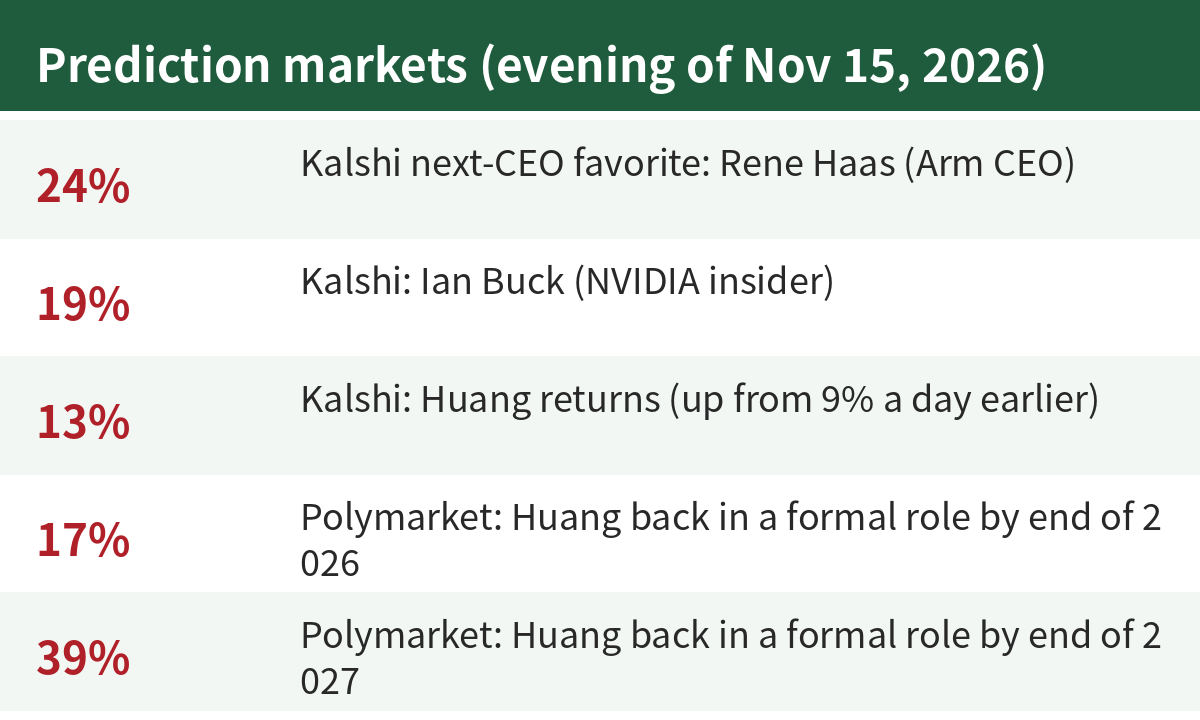
- Kalshi (evening of November 15): Rene Haas leads the next-CEO market at 24%. NVIDIA’s Ian Buck is at 19%. Huang’s return is priced at 13%, up from 9% the day before
- Polymarket: a 17% chance that Huang rejoins NVIDIA in a formal role by the end of 2026, and 39% by the end of 2027
Two things to note. First, Haas — not Huang — remains the favorite. Second, the move from 9% to 13% in a day shows the market’s read is shifting, even if a comeback is still not the base case.
Earnings on November 18: the first real test
NVIDIA reports fiscal third-quarter results after the US close on November 17 — the morning of November 18 in Japan. It will be the first earnings release since the resignation, presented by interim CEO Colette Kress.
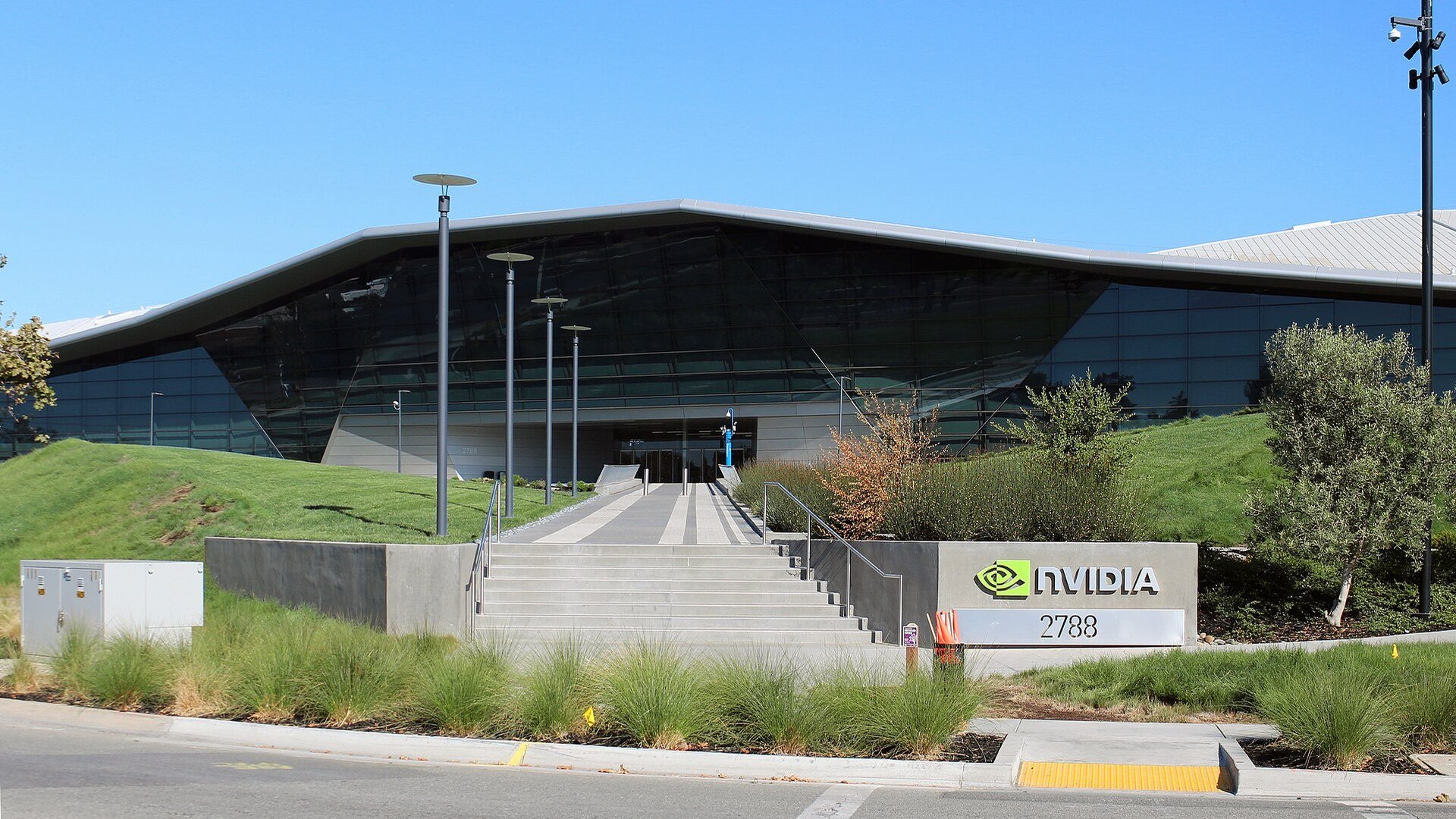
The stock closed at $162.85 on November 13, roughly 33% below its 52-week high, after a heavy week of selling. Beyond the numbers themselves — revenue, data center sales, guidance — how far the earnings call goes on the succession question could drive the stock in the short term.
Our view: more than the return question itself, it is the uncertainty over when and how the board decides that weighs on the shares. If the Kress interim team delivers clean numbers, the “NVIDIA works without Jensen” case gets stronger. Either way, the November 18 earnings are the next fork in this story.
Summary
- A Huang return is a reported discussion, not a decision
- The petition stands at 159,089 signatures (campaign count); Kalshi prices a return at 13%
- Only the board decides; the Treasury Secretary wants an outsider
- Earnings on the morning of November 18 (Japan time) are the first test
We will cover the results as soon as they are out.
Sources
- Financial Times (reports of November 13 and 15, 2026); Reuters (November 15, 2026)
- Signature count: Stand with Jensen campaign tally, evening of November 15, 2026
- Prediction markets: Kalshi and Polymarket, evening of November 15, 2026
- Share price: close of November 13, 2026
Photo credits: Jensen Huang: Anders Eidesvik, CC BY-SA 4.0 / CC BY 4.0, via Wikimedia Commons / NVIDIA headquarters: Coolcaesar, CC BY-SA 4.0, via Wikimedia Commons
Update: The Shock Spreads to Taiwan’s Market (Nov 16)
The shock from Jensen Huang’s resignation has hit Taiwan’s market head-on.
- Taiwan’s TAIEX plunged as much as 1,872.91 points intraday on November 16 — the eighth-largest intraday drop on record — touching an intraday low of 41,802 (source: ETtoday and other Taiwan media).
- Delta Electronics hit its daily limit down, and Foxconn fell more than 7%.
- Yang Chin-long, governor of Taiwan’s central bank, told parliament that the resignation is “a turbulence with a major impact” on financial markets. He added that the reasons behind the resignation remain unclear and that the new leadership’s direction needs watching.
Taiwan is the production heartland of Nvidia’s AI servers and supply chain. The resignation is no longer one company’s personnel story — it is now shaking an entire market.
What to watch next: Nvidia’s earnings, due early on November 18, Japan time. What the new leadership says about the succession and the supply chain will decide whether this turbulence settles or spreads.
We also covered this in a breaking Short: https://www.youtube.com/watch?v=lRropFR3aiM
Update 2: Administration Set to Name Nvidia an AI “National Champion” (Nov 16)
The shock from CEO Jensen Huang’s resignation has not settled. Nvidia’s market value has fallen from about $5.8 trillion in early October to about $3.9 trillion on Friday — roughly $1.9 trillion gone (LSEG data).
The fallout has spread to Japan. On November 16, the Nikkei fell more than 1,200 yen at one point, dropping below 60,000. It closed the morning session at 60,182.50, down 959.85 yen (-1.57%). AI and semiconductor stocks led the decline, following a 3.43% drop in the Philadelphia Semiconductor Index (SOX) in the U.S. the previous Friday.
Then, on the eve of earnings, major policy news arrived. The Trump administration is set to name Nvidia among more than 25 AI “national champions” (WSJ, via Reuters). Amazon, Microsoft, OpenAI and Anthropic are also on the list, and Commerce Secretary Howard Lutnick is expected to announce it within a week. The aim is to get foreign companies and countries to adopt U.S. AI technology over Chinese rivals. The program itself was announced about a year ago, but the companies had never been named until now.
What Happens Next
What the designation actually does: The substance is still unclear — whether it means help winning overseas orders, a different treatment on export controls, or financial backing. Until the announcement’s details are known, its effect on the stock cannot be measured. But the message itself is clear: even in the middle of the resignation turmoil, the administration is not cutting Nvidia loose — it is putting the company at the center of national policy.
What earnings must answer: In the results due early on November 18, Japan time, the focus is whether revenue reaches the roughly $109 billion consensus (LSEG) and whether the bullish outlook for next year holds. What interim CEO Colette Kress says about the succession and the supply chain will also matter.
Our view: The policy tailwind could offset the “governance discount” from the resignation shock. But while the designation’s substance remains unclear, the earnings numbers come first. The right order is: check the results, then check the policy details.
We also covered this in a breaking Short: https://www.youtube.com/shorts/al8LvJqqpCQ
(Sources: WSJ, Reuters, TBS NEWS DIG, LSEG)