Tag: Quantum Computing

  • IonQ vs. Rigetti vs. D-Wave: Is IonQ’s Lead Real? Comparing the Three Pure-Play Quantum Computing Stocks

    IonQ vs. Rigetti vs. D-Wave: Is IonQ’s Lead Real? Comparing the Three Pure-Play Quantum Computing Stocks

    Hello, this is Bota Labo.

    Quantum computing has moved beyond university research labs and entered the stage of commercial procurement, with government agencies and global enterprises now placing real orders. At the forefront of this shift are the three listed pure-play quantum computing companies in the United States: IonQ, Rigetti, and D-Wave.

    IonQ has already reported its third-quarter earnings, surprising the market with record-breaking figures. Rigetti and D-Wave are set to report their earnings from tonight through tomorrow morning. Following IonQ’s strong results, shares of both companies rallied ahead of their earnings announcements (Rigetti +19%, D-Wave +18%). However, a sympathy rally is not the same as fundamental strength. This article compares the fundamentals of all three companies and highlights the key figures to watch in their earnings.

    Basic Comparison of the Three Companies

    CompanyTechnologyRevenueBacklogCash on HandEarnings Status
    IonQTrapped-ion$173.83 million (Q3 actual, +336% YoY)More than $1.2 billionApproximately $1.1 billion (as of Q3)Reported
    RigettiSuperconductingQ2 actual: $5.14 million / Q3 estimate: approximately $3.52 millionIncluding the $8.4 million C-DAC contractApproximately $541 million (as of Q2)Reporting tomorrow morning
    D-WaveQuantum annealing + gate modelQ2 actual: $3.08 million / Q3 estimate: approximately $4.34–$4.37 million$40.7 million (+668% YoY)Approximately $546.2 million (as of Q2)Reporting tonight

    Looking at the numbers, IonQ is currently operating on an entirely different scale. However, the three companies use completely different technologies, and the timing of when each can generate revenue also differs.

    Differences in Technology: Strengths and Weaknesses

    IonQ (Trapped-Ion Technology)

    This approach uses lasers to control ions. Its strengths include high two-qubit gate fidelity of 99.99% and all-to-all connectivity, in which every qubit is directly connected to every other qubit. Because the system operates in a room-temperature vacuum environment, it does not require large-scale refrigeration and is easier to install in data centers. On the other hand, gate operations are slower than in superconducting systems, and scaling up faces challenges related to moving ions (shuttling) and optical interconnects. In June 2026, IonQ reported that its new quantum error-correction approach, qLDPC, had pushed error rates past the break-even point, making it possible to create logical qubits with fewer physical qubits.

    Rigetti (Superconducting Technology)

    Rigetti uses superconducting circuits, the same general technology employed by Google and IBM. Gate operations are extremely fast, on the order of nanoseconds, and the approach can leverage semiconductor manufacturing technology. The company operates its own fabrication facility, Fab-1, in California. Its 84-qubit Ankaa-3 system has achieved 99.5% gate fidelity. Its weaknesses include the need for dilution refrigerators to cool the system to temperatures near absolute zero, the very large number of physical qubits required for error correction, and supply risks for helium-3 used in refrigeration.

    D-Wave (Quantum Annealing + Gate Model)

    D-Wave is a pioneer in quantum annealing, an approach specialized in combinatorial optimization problems. Its latest system, Advantage2, features more than 4,400 qubits. One of its major strengths is its extensive track record of real-world production use by large enterprises in logistics and financial optimization. However, quantum annealing cannot perform general-purpose quantum computing. D-Wave therefore entered the gate model through the technology of Quantum Circuits (QCI), which it acquired in January 2026, but this effort lags the other two companies by several years.

    Where the Companies Stand: Major Contracts

    IonQ: Selected for Stage C, the final phase of the Defense Advanced Research Projects Agency (DARPA) Quantum Benchmarking Initiative (program value of up to $300 million). It also has a $25 million system deployment at Florida International University and a $28 million contract to provide optical atomic clocks, giving it a strong pipeline of defense and academic orders. It acquired semiconductor foundry SkyWater for approximately $1.8 billion, bringing manufacturing in-house.

    Rigetti: Selected as a potential recipient of up to $100 million in funding support under the CHIPS Act, subject to conditions. It has an $8.4 million system order from C-DAC, a government-affiliated research institution in India, and sales of its small QPU, Novera, to the U.S. Air Force Research Laboratory, building a track record in hardware sales.

    D-Wave: Its $20 million Advantage2 sale and installation project at Florida Atlantic University is the primary driver of its sharp increase in backlog. It also has a multi-year cloud contract of approximately $10 million with a Fortune 100 company.

    IonQ’s Q3 Results as the Benchmark

    IonQ’s third-quarter results provide a useful benchmark for comparing the three companies. Revenue reached $173.83 million, up 336% year over year. Gross margin was 52.5%, and the company raised its full-year guidance to $505–$515 million. Backlog exceeded $1.2 billion. More details are available in our IonQ earnings analysis article. Net loss was approximately $410 million, which appears substantial. However, much of this figure resulted from non-cash accounting adjustments related to changes in the valuation of warrant liabilities.

    What to Watch in Rigetti’s Earnings

    The market expects revenue of approximately $3.52 million and EPS of -$0.052. The projected revenue is lower than the $5.14 million reported in Q2. This is because Rigetti’s business is subject to revenue fluctuations depending on the timing of large system deliveries. There are three key points to watch.

    1. Progress on the C-DAC Contract

    The company has indicated that revenue from the $8.4 million order is expected to be recognized after installation and acceptance testing in Q4. The most important thing to watch is whether management confirms that the project is progressing as scheduled.

    2. CHIPS Act Funding

    Investors should look for concrete progress on the potential funding support of up to $100 million.

    3. Cash Runway

    Rigetti had approximately $541 million in cash on hand. Its Q2 quarterly net loss was approximately $52.6 million, including non-cash items. While revenue remains relatively small, the key valuation question is how many years the company can continue operating with its existing cash reserves.

    What to Watch in D-Wave’s Earnings

    The market expects revenue of approximately $4.34–$4.37 million and EPS of around -$0.10. Management has indicated that Q3 revenue should be slightly higher than Q2, with the main revenue opportunity coming in Q4. There are three key points to watch.

    1. Converting Backlog into Revenue

    D-Wave’s backlog stands at $40.7 million, up 668% year over year. The key question is how quickly this backlog is being converted into recognized revenue.

    2. Delivery of the Florida Project

    Will installation begin before the end of the year, or will revenue recognition slip into 2027? Expected Q4 revenue is substantial, at approximately $32.37 million. If the Florida project or other Q4 deliveries falter, the full-year outlook could be undermined.

    3. Share Dilution and Cash Management

    D-Wave’s outstanding share count has more than doubled over the past three years. In January 2026, the company also registered an additional equity financing facility of approximately $330 million, so investors should also watch the pace at which equity raises are diluting shareholder value. Put another way, the central question for D-Wave is whether the pace of converting its backlog into revenue can outpace the dilution from equity financing.

    Risks to Keep in Mind

    All three companies share several common risks. First, revenue recognition can lag by several quarters because the process typically follows the sequence of contract, installation, and acceptance. Second, research and development expenses are substantial, and operating cash flow remains negative. Third, non-cash items, such as warrant valuation adjustments, can cause significant fluctuations in GAAP net loss. As a basic rule, investors should evaluate three figures together when reviewing earnings: revenue, backlog, and cash on hand.

    Summary: The Checklist

    What will determine the share price reactions is not simply the Q3 numbers themselves, but whether the companies maintain or revise their Q4 outlooks. Both Rigetti’s C-DAC project and D-Wave’s Florida project have revenue recognition concentrated around Q4 acceptance and delivery, so judging them on Q3 figures alone would be misleading.

    • IonQ: Can it maintain its lead, backed by a backlog exceeding $1.2 billion?
    • Rigetti: Can it exceed expectations through the C-DAC contract ($8.4 million) and CHIPS Act funding support (up to $100 million)?
    • D-Wave: Can it demonstrate a clear path to converting its $40.7 million backlog and Florida project ($20 million) into Q4 revenue?
  • IonQ’s CFO & COO Steps Down Effective Immediately: Why Did Arm’s Star Finance Chief Leave After 14 Months?

    IonQ’s CFO & COO Steps Down Effective Immediately: Why Did Arm’s Star Finance Chief Leave After 14 Months?

    Hello, this is Bota Labo.

    Something unusual has happened at quantum computing company IonQ. Inder M. Singh, the company’s Chief Financial Officer (CFO) and Chief Operating Officer (COO), has stepped down effective immediately.

    The announcement came before the U.S. market opened on Friday, November 13. What’s more, less than 10 days had passed since Singh himself presented the company’s record-breaking earnings results.

    The bottom line: Looking only at the new leadership lineup, this appears to be a strengthening of the management structure. But the lack of transparency surrounding Singh’s departure has raised questions in the market.

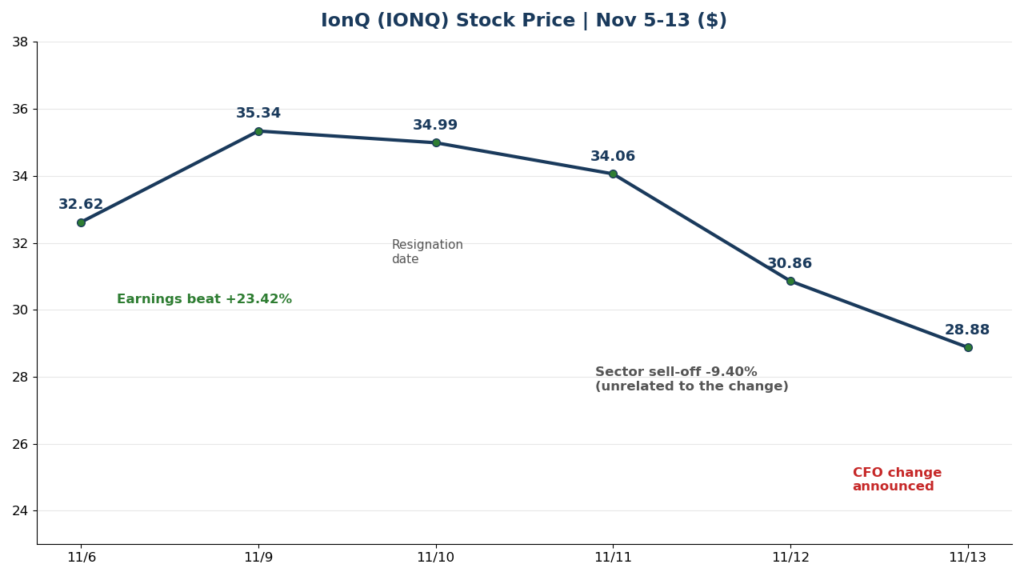
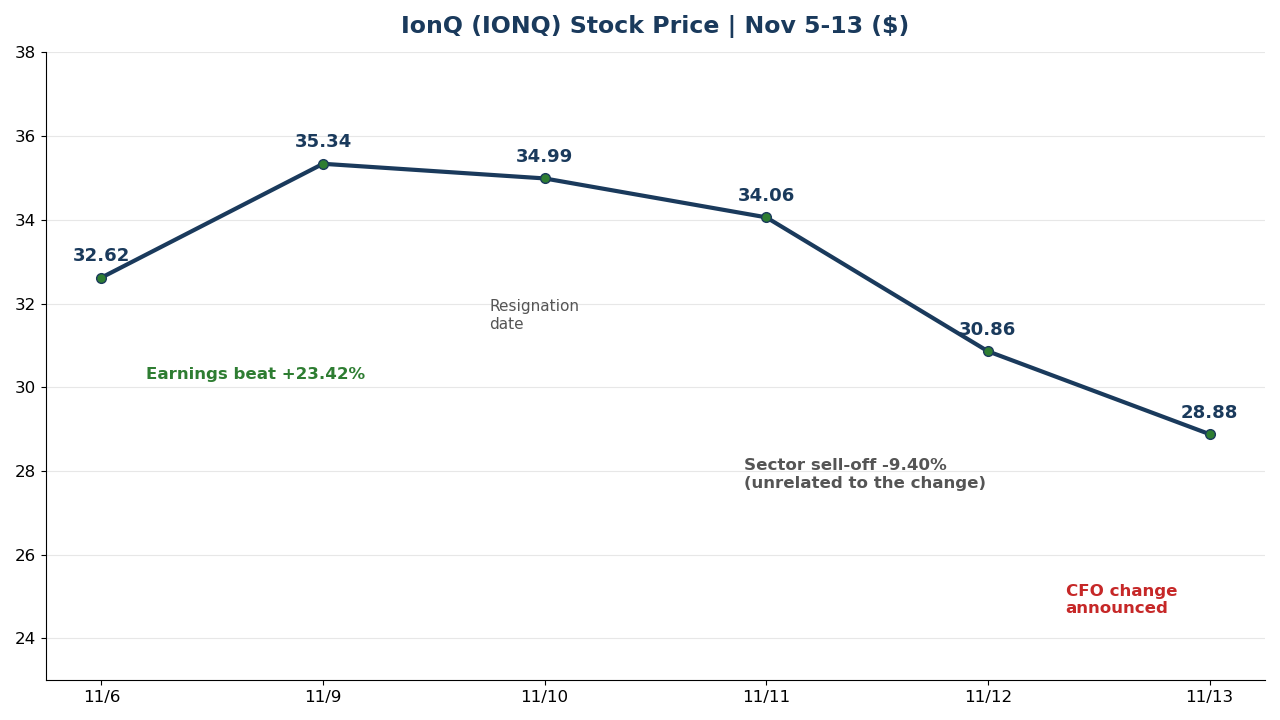
    IonQ shares closed at $28.88 on the day of the announcement, down 6.42% from the previous close. However, the previous day’s 9.40% decline and analysts’ price target cuts need to be considered separately from this management change.

    In this article, we’ll examine who Singh was, who will replace him, and how investors should interpret the implications.

    What Happened: He Was Gone Five Days After Presenting Earnings

    First, let’s look at the timeline (all dates and times are U.S. time).

    • November 5: IonQ announced its Q3 results. Revenue reached a record $173.83 million, up 336% year over year. Singh personally led the earnings presentation.
    • November 10: Singh stepped down (the date recorded in the SEC-filed Form 8-K). This was not publicly disclosed at the time.
    • November 13, 8:30 a.m. (Eastern Time): The company formally announced the executive transition. On the same day, it also filed a prospectus supplement registering 34,580,646 shares for resale.
    • December 3 (scheduled): Gary Merrill is expected to take over as CFO.

    There are three important points.

    First, the departure was effective immediately. When his predecessor left, the transition arrangements allowed that executive to remain as an advisor for up to 60 days. There is no such provision mentioned this time.

    Second, no reason for Singh’s departure has been disclosed. The announcement contains only a comment from CEO de Masi expressing gratitude and wishing him success in his future endeavors.

    Third, while a successor for the CFO position has been named, no replacement for the COO role has been announced. The company has not explained who will assume the operational responsibilities previously handled by Singh.

    IonQ headquarters in College Park, Maryland
    IonQ headquarters in College Park, Maryland. Photo: Blacktupelo / CC BY-SA 4.0 (Wikimedia Commons)

    Who Was Singh? The Finance Heavyweight Behind Arm’s IPO

    Singh is a veteran finance executive with more than 30 years of experience in finance and corporate strategy.

    Inder M. Singh
    Inder M. Singh. Photo: Business Wire

    His career includes serving as EVP and CFO of Arm, the major British semiconductor design company, from April 2019 to December 2022. He handled much of the preparation for Arm’s IPO, which became the largest IPO of 2023.

    Before that, he served as CFO of Unisys and held senior positions overseeing financial strategy and M&A at Cisco. Earlier in his career, he also worked as an equity analyst on Wall Street. In other words, he has viewed corporate finances from both sides of the table: the capital markets and corporate management.

    His relationship with IonQ goes back several years. He joined the company’s board of directors as a member of the audit committee in December 2021 and later served as Lead Independent Director. In other words, he was one of the central figures overseeing the company’s management.

    On September 4, 2025, Singh stepped down from the board and took on the roles of CFO and COO himself.

    His compensation package upon joining was substantial. It included a base salary of $500,000, RSUs worth $6.75 million, performance-based RSUs with a target value of $18 million, and additional compensation to make up for incentives forfeited at his previous employer.

    There is little doubt that he was brought in with considerable fanfare.

    During his approximately 14 months in the role, IonQ underwent major changes.

    The company acquired SkyWater (approximately $1.8 billion in total, with completion in July 2026) and Elisity (completed on November 3, 2026). In October 2026, Singh also led a $2 billion public offering as CFO, bringing the company’s cash and investments to approximately $3.7 billion.

    Since December 2024, IonQ has completed 12 acquisitions totaling approximately $6.2 billion.

    The finance executive responsible for this aggressive expansion strategy had already left just five days after presenting the company’s best-ever earnings results.

    That is the central issue here.

    New CFO Merrill and the New Management Structure: Two Veterans in Finance and Accounting Join at Once

    IonQ’s new CFO will be Gary Merrill, the current CFO of Commvault, a major data protection company. He is scheduled to take office on December 3.

    Merrill has spent more than 20 years at Commvault, including 15 years in its finance organization.

    During his tenure as CFO from 2022 to 2024, he led a transformation of the finance organization and the company’s transition to a subscription/SaaS model. He subsequently served as Chief Commercial Officer, overseeing sales and partner organizations and supporting double-digit ARR growth.

    He had only recently returned to the CFO role in April 2026. Merrill brings experience at a mature publicly listed company with revenue on the scale of $1 billion, having worked in both finance and sales.

    Incoming CFO Gary Merrill
    Incoming CFO Gary Merrill. Photo: Commvault

    CEO de Masi cited Merrill’s experience as a public company CFO and his deep knowledge of cybersecurity as the reasons for his appointment.

    Merrill himself commented that “IonQ’s strong balance sheet is a clear competitive advantage in the quantum industry.”

    At the same time, Thomas A. Austin was appointed effective immediately to the newly created position of Chief Accounting Officer (CAO).

    Austin spent six years as CAO at Juniper Networks and is an accounting specialist who has overseen internal controls and SEC reporting.

    One additional point worth noting: for the approximately three weeks until Merrill takes office on December 3, Chairman and CEO de Masi will also serve as interim CFO.

    This means there will be a transition period during which the CEO holds three roles simultaneously.

    CEO Niccolo de Masi
    CEO Niccolo de Masi. Photo: Isabella1517 / Wikimedia Commons, CC BY-SA 4.0

    Separating the Impact: Share Price, Analysts, and Resale Registration

    Let’s now distinguish between developments directly related to the executive transition and those that are not.

    Share Price: Down 6.42% on Announcement Day. The Previous Day’s 9.40% Drop Was Unrelated

    IonQ (IONQ) share price, Nov 5-13
    IonQ (IONQ) share price, Nov 5-13

    The 9.40% decline on November 12 was unrelated to the management change.

    That day, October CPI came in above expectations, and the U.S. 10-year Treasury yield surged into the 5% range. These developments coincided with management turmoil at Nvidia and earnings misses from Rigetti and D-Wave, triggering a broad sell-off across quantum computing stocks.

    At that point, IonQ’s executive transition had not yet been publicly announced.

    On November 13, the day the transition was announced, IonQ shares fell 6.42%.

    The stock briefly fell more than 8% intraday, but trading volume was 21.58 million shares, approximately 12% below average. This suggests that the decline was driven more by cautious selling and uncertainty than by panic-driven dumping.

    Some overseas media outlets have reported the decline as “7%,” but that is a rounded figure. The confirmed closing-price decline was 6.42%.

    Analysts: Price Target Cuts Came Before the Executive Change

    The narrative that “analysts rushed to cut their price targets in response to the executive transition” gets the sequence wrong.

    Almost all the price target reductions we could confirm occurred around November 6, immediately after the Q3 earnings announcement and before the management change was made public.

    The reason was not the personnel change, but a decline in valuation multiples across the quantum sector as a whole.

    BofA is a particularly telling example.

    The firm raised its revenue forecasts for IonQ to $510 million in 2026, $950 million in 2027, and $1.5 billion in 2028. However, it lowered its valuation multiple, resulting in a reduced price target.

    All the firms maintained their “Buy” ratings. As of the morning of November 14, we could not confirm any new analyst downgrades following the executive transition announcement.

    Resale Registration: The 34.58 Million Shares Have Simply Become Eligible for Sale

    On the same day as the executive transition announcement, IonQ also filed a resale registration covering 34,580,646 shares held by existing shareholders.

    This is not a fundraising procedure through which the company issues new shares to raise capital. Rather, it allows existing holders to sell their shares in the market. IonQ itself receives no cash from these sales.

    To put the size into perspective, 34,580,646 shares represent approximately 8% of the company’s total outstanding shares (approximately 429 million).

    In dollar terms, overseas media outlets reported a value of approximately $1.15 billion, based on an estimated share price of approximately $33.

    Using IonQ’s November 13 closing price of $28.88, the value comes to approximately $1 billion.

    Filing a prospectus does not mean the shares will immediately be sold. Nevertheless, the fact that these shares have become eligible for sale at any time creates a potential supply overhang that investors are likely to watch.

    The following breakdown is speculative.

    IonQ’s acquisition of Elisity, completed on November 3, was entirely stock-based, with 32,233,274 shares issued as consideration.

    That figure is close to the number of shares covered by the latest registration. Since acquisition consideration shares typically come with rights to have them registered for resale, it is highly likely that the registration is closely related to the Elisity acquisition.

    However, we have not been able to confirm the breakdown of the approximately 2.35 million-share difference.

    Two Sides of the Story: Strengthening the Organization or a Sign of Trouble?

    Based on everything discussed so far, there are two ways to interpret this development.

    The Case for a Stronger Management Structure

    The company has positioned the personnel changes as part of its efforts to support “continued growth and a path toward profitability.”

    Both incoming executives are experienced veterans of finance and accounting at publicly listed companies. The creation of a new CAO position also points toward an expansion of the management structure.

    The fact that a sitting CFO at an established public company was willing to move to IonQ could itself be interpreted as a sign of confidence in the company’s future.

    IonQ’s financial position is strong, with approximately $3.7 billion in cash and investments and $1.2 billion in remaining performance obligations (backlog).

    This is not a management change driven by immediate funding pressure.

    Most analysts continue to maintain “Buy” ratings even after lowering their price targets (as of November 6).

    The Case for Concern: Unusual Circumstances and a Lack of Transparency

    Tickeron summarized the situation by noting that “the sudden departure of the finance chief just weeks after record earnings and a major capital raise raises questions about reporting, controls, and strategy that the announcement does not answer.”

    Invezz pointed out that “financial leadership uncertainty has been added at precisely the time when disciplined spending and acquisition integration are needed.”

    To summarize the reasons for concern, there are six points:

    1. No explanation whatsoever has been provided for Singh’s departure.
    2. There is a three-day gap between his departure date (November 10) and the public announcement (November 13).
    3. An executive who was recruited from the board with a substantial compensation package has left after just 14 months.
    4. The CFO position will remain vacant for approximately three weeks immediately before the year-end financial results, with the CEO holding three positions simultaneously.
    5. No successor to the COO position has been announced.
    6. A resale registration covering approximately $1 billion worth of shares was filed on the same day.

    Our Assessment and What to Watch Next

    Here is how we assess the situation at this point.

    Looking only at the new management lineup, this is a strengthening of the organization. However, the lack of an explanation for the circumstances surrounding Singh’s departure has led the market to discount the stock accordingly.

    At the same time, the underlying business figures have not deteriorated.

    Q3 revenue was up 336% year over year. The full-year revenue guidance was raised to $505 million-$515 million, and the backlog stands at $1.2 billion.

    Regarding the integration of SkyWater, the head of foundry operations remains in place. There have been no disclosures or reports indicating that integration is falling behind schedule.

    We believe the main challenge is less about the day-to-day operation of the factories themselves and more about the burden on the teams responsible for producing the financial numbers: acquisition accounting, consolidated financial reporting, and internal controls, particularly given the goodwill balance that has grown to approximately $3.2 billion.

    That is precisely why the decision to bring in both an executive experienced in financial organization reform and an accounting specialist at the same time makes sense as part of a coherent strategy.

    There are four key things to watch next.

    1. Merrill’s appointment on December 3 and any additional disclosures around that time, including Singh’s departure terms and Merrill’s compensation package.
    2. Whether IonQ announces a successor to the COO position.
    3. Whether the company maintains its full-year guidance in its Q4 and full-year results, scheduled for late February 2027, and how the new management team explains its strategy.
    4. Whether analysts make any new rating or price target changes in response to the executive transition announcement.

    The central question – “Why was the departure effective immediately?” – will remain unanswered until the company provides further disclosures.

    Rather than filling the gaps with speculation, we believe the right approach is to monitor the next disclosures and evaluate the situation based on what the company actually reveals.

    Disclaimer: This article is intended for informational purposes only and does not constitute a recommendation to buy or sell any specific securities. All investment decisions are your own responsibility.