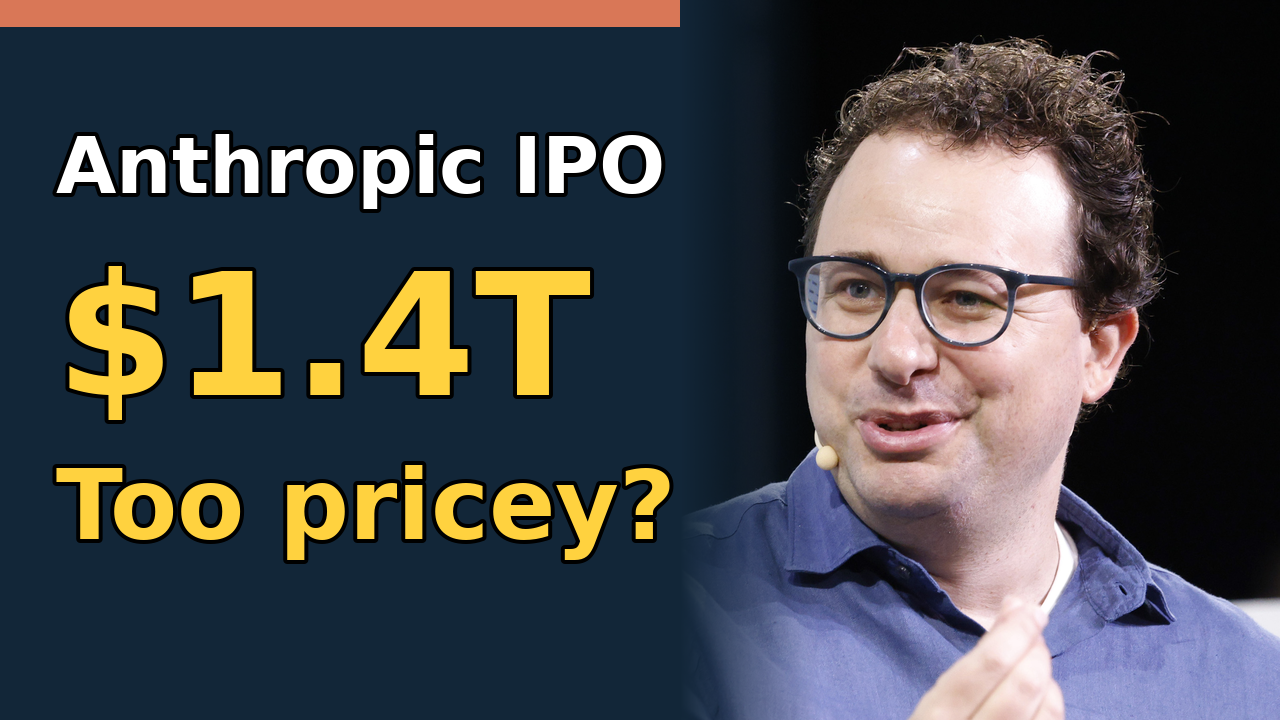
Our conclusion first: don’t go all-in on day one
On November 19, 2026, a company valued at roughly $1.4 trillion on a fully diluted basis is scheduled to list on the Nasdaq. That company is Anthropic, the developer of the AI model Claude. Its IPO is one of the largest ever — a price range of $70 to $78 per share, with some 825 million shares on offer.
Anthropic is, without question, a remarkable growth company. But a great company and a great price to buy it at are two different things. In our view, this IPO is worth watching closely — but not worth chasing with your full position on the first day.
Our approach, in short:
- Don’t go all-in on day one. At a reported fully diluted valuation of about $1.4 trillion, a great deal of future growth is already priced in.
- If you want exposure, build it slowly, in small staged amounts. There will be better moments to add.
- The real decision points come later: the first earnings report after listing, and the lock-up expiry. Those are the moments to judge whether the growth story in the S-1 is still holding up.
This article walks through the filing, number by number, so you can see for yourself why we take that view.
What is Anthropic?
Anthropic is the American AI company behind Claude, one of the main rivals to OpenAI’s ChatGPT. It was founded in 2021 by a team that included former OpenAI researchers, and its chief executive is Dario Amodei.
From the beginning, Anthropic has built its brand around AI safety — the idea that AI should be made not only more capable, but also safer and more trustworthy. That positioning matters commercially, because Anthropic’s business is not mainly about consumer chatbots. Its revenue comes largely from two enterprise channels: API access, where companies and developers embed Claude into their own products, and enterprise AI services, where companies pay for Claude to support internal work such as development and analysis.
In other words, Anthropic is not selling a novelty. It is trying to become part of the infrastructure its corporate customers use every day. The most striking number in the S-1 suggests that shift is already happening — but we will get to that below.
Anthropic is incorporated as a public benefit corporation (PBC). Its governance is unusual: voting control is concentrated in a Long-Term Benefit Trust and a Founder LLC, a structure the filing itself flags as a risk because it can conflict with ordinary shareholder interests.
The S-1 numbers: revenue that barely looks real
The revenue growth in the filing is extraordinary by any standard. Anthropic’s annual revenue went from $386 million in 2024 to $4,585 million in 2025 — roughly a 12-fold increase in a single year. And the pace has not slowed: revenue for the first nine months of 2026 was $33,242 million, compared with $2,545 million in the same period of 2025 — about 13 times higher.
The quarterly detail is just as striking. In the third quarter of 2026 alone (July–September), revenue was $16,956 million, up 1,127% year on year according to the filing, and up 47% from the second quarter’s $11,555 million. And the run-rate — the pace of recent revenue annualised — stood at approximately $81 billion as of October 31, 2026, up $10 billion from September 30.
| Period | Revenue | Context |
|---|---|---|
| 2024 (full year) | $386 million | Base year |
| 2025 (full year) | $4,585 million | ~12x year on year |
| Jan–Sep 2025 | $2,545 million | Comparison period |
| Jan–Sep 2026 | $33,242 million | ~13x year on year |
| Q2 2026 | $11,555 million | — |
| Q3 2026 | $16,956 million | +1,127% year on year; +47% vs Q2 |
| Run-rate (Oct 31, 2026) | ~$81 billion | +$10 billion from Sep 30 |
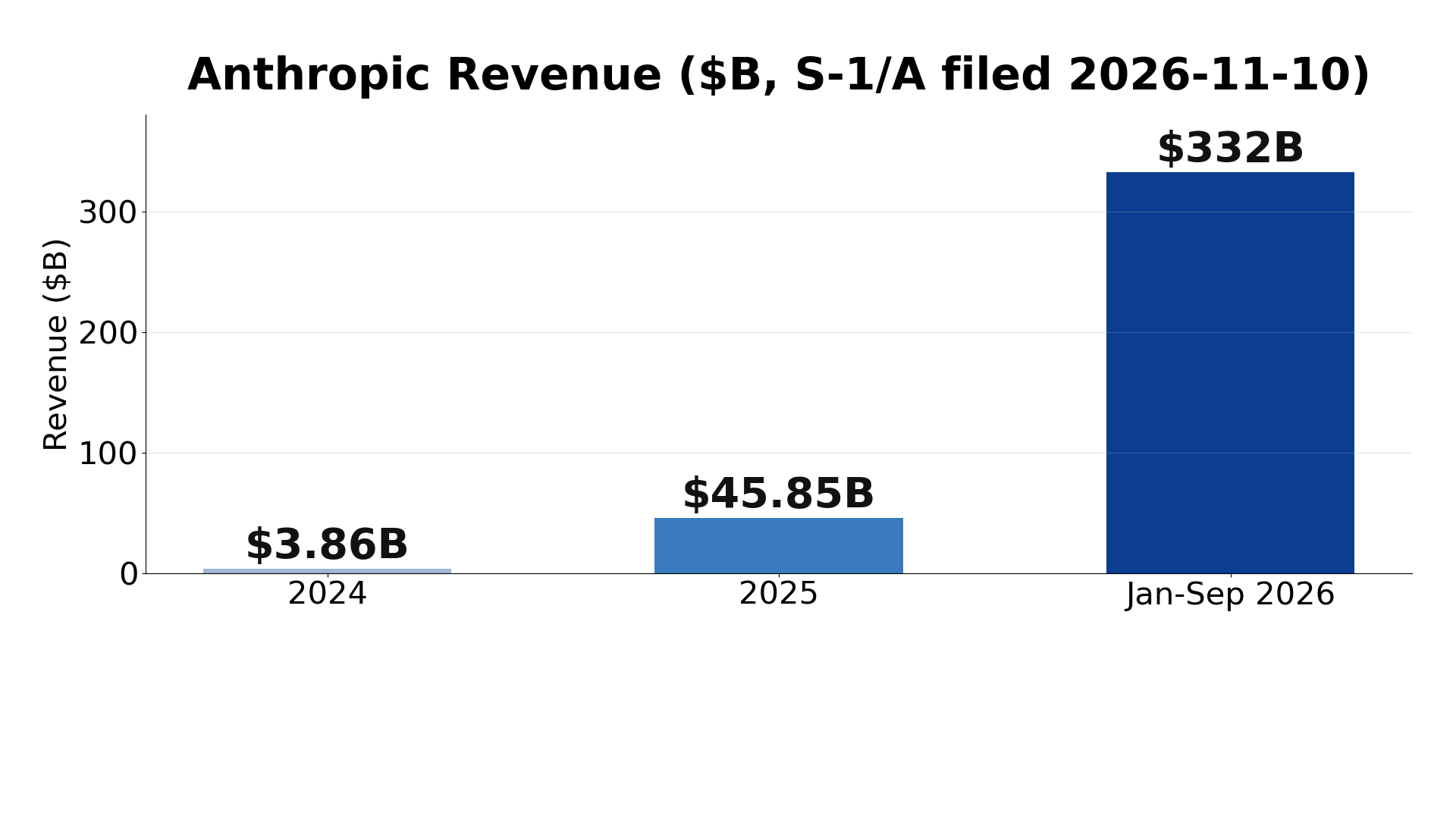
Source: Anthropic, Form S-1/A, filed November 10, 2026 (SEC EDGAR).
But revenue is only half the story. For an AI company, the question is always how much compute it costs to earn that revenue. Here the S-1 shows real improvement. Compute costs were 160% of revenue in 2025 ($7,326 million), meaning the company was spending more on compute than it took in. In the first nine months of 2026, that ratio had fallen to 57% ($18,808 million). Spending more efficiently per dollar of revenue is exactly the direction a business like this needs to move in.
Losses are narrowing too, at the operating level. The third quarter of 2026 produced an operating loss of $567 million — still a loss, but far smaller relative to revenue than before, and the second quarter of 2026 was actually profitable on an operating basis, with $974 million of operating income. The operating loss for the first nine months of 2026 was $1,260 million.
So why does the same filing show a net loss of $104,039 million for January–September 2026? The answer is accounting, not cash. The main driver was a $94,324 million charge for changes in the fair value of convertible notes, derivative liabilities and SAFEs — a non-cash revaluation driven by the increase in Anthropic’s enterprise valuation. In plain terms, as the company became more valuable, the accounting value of its convertible instruments rose, and that increase was booked as a loss. It is not the same as $104 billion of cash leaving the company. The accumulated deficit stood at $156.2 billion at the end of the period, again largely reflecting these accounting effects.
There is one more number that captures the strength of the business model: net revenue retention (NRR) was approximately 900% as of September 30, 2026. That means existing customers — specifically, qualified customers measured on a comparable three-month basis, excluding Claude Pro, Max and Ultra subscribers — spent about nine times as much as they did a year earlier. This is not growth from new customers. It is the same companies using Claude far more than before. That is the pattern you would expect if AI is moving from an experiment to an everyday part of corporate work.
The $900.9 billion commitment — and the strange circle of money
Now we come to the part of the S-1 that deserves the most attention. Anthropic has committed to an aggregate spend of approximately $900.9 billion on compute and infrastructure — a figure the filing itself discloses, measured as of September 30, 2026 plus contracts signed afterwards. About $451.6 billion of that falls due by the end of 2030, with the rest largely due between 2031 and 2045.
Even the near term is large: about $70.7 billion is due within 12 months of September 30, 2026, of which roughly $4.2 billion is conditional or cancellable. On top of the $900.9 billion, the filing discloses potential payments of $150 billion to $175 billion under arrangements that do not specify a fixed dollar commitment, and notes that about $186.2 billion of the total is cancellable or subject to conditions precedent.
The biggest individual commitments show where the money is going:
| Counterparty | Commitment | Period |
|---|---|---|
| Microsoft | $47.2–49.2 billion (minimum–maximum, take-or-pay) | Nov 2026 – Jun 2033 |
| ~$121.3 billion (cloud hosting minimum) | Apr 2026 – Jul 2033 | |
| Amazon (AWS) | $110.0 billion (minimum) | May 2026 – Apr 2036 |
| SpaceXAI | Up to $120.5 billion | Through 2029 (cancellable on 90 days’ notice after initial period) |
| Broadcom | ~$161.2 billion (equipment leases, excl. interest) | — |
| Nscale | Up to ~$44.6 billion | — |
| Lambda | ~$41.3 billion | — |
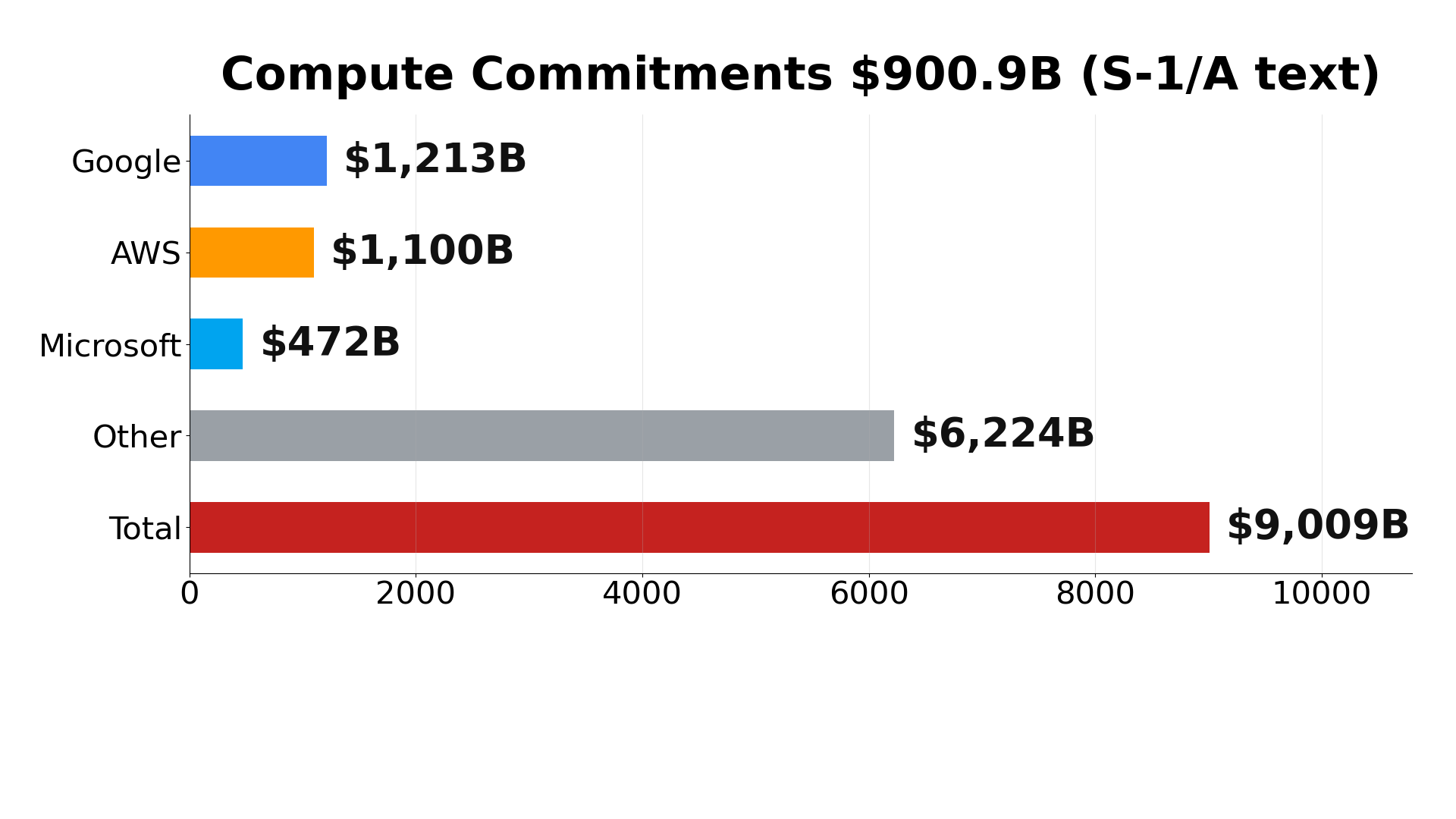
Source: Anthropic, Form S-1/A, filed November 10, 2026 (SEC EDGAR). The three largest named commitments alone total about $278.5 billion.
That is a huge bill for a company whose nine-month revenue was $33.2 billion. It is also, in our view, the most interesting structural feature of this IPO — because the companies receiving that money are largely the same companies funding Anthropic.
Alongside the public offering, Anthropic is running a concurrent private placement of $26.0 billion in Class N shares, at the same price as the IPO, to seven companies: Advanced Micro Devices, Broadcom, Google, Micron Technology, Microsoft, NVIDIA and TSMC Partners. Google’s share of that placement is confirmed in the filing at $10.0 billion; the individual amounts of the other six are not disclosed in the S-1. Amazon and Google are also among Anthropic’s largest shareholders: after the offering and the private placement, Amazon is set to hold 1,920,511,218 Class N shares (about 14.7% of total shares outstanding), with a further 1,563,617,444 shares issuable on conversion of notes it holds, and Google is set to hold 1,789,598,269 Class N shares (about 13.7%).
So the same group of companies is, at once, Anthropic’s investor, its supplier of chips and cloud capacity, and in many cases its customer. Anthropic’s growth creates demand for semiconductors and cloud services; the companies that supply those services invest in Anthropic; and they also use its AI. That is not necessarily a bad thing — it can be read as a vote of confidence from the companies that know this industry best. But it is a deeply interdependent structure, and it cuts both ways: the more Anthropic grows, the more compute it must buy, and the more it depends on keeping these relationships intact.
Is $1.4 trillion fair? The IPO terms in detail
The offering itself is mostly new shares, which means the money goes to the company to fund growth rather than to existing shareholders cashing out. The details, from the S-1 cover page:
- Shares offered: 825,000,000 in total — 801,351,354 new shares from the company and 23,648,646 shares sold by existing shareholders.
- Price range: $70.00 to $78.00 per share.
- Overallotment option: a further 123,750,000 shares.
- Concurrent private placement: $26.0 billion (see above).
- Net proceeds: approximately $84.6 billion at the $74 midpoint, including the private placement.
- Ticker: ANT, on the Nasdaq. Lead underwriters are Goldman Sachs and Morgan Stanley. Pricing is expected on November 18 (U.S. time), with listing expected on November 19, according to press reports.
- Shares outstanding after the offering and placement: 13,086,672,593 across all classes (13,210,422,593 if the overallotment option is fully exercised). At the top of the range, $78, that implies a market capitalisation of roughly $1.02 trillion on an issued-share basis.
- Fully diluted valuation: about $1.4 trillion, as reported — this figure is not stated directly in the S-1. It reflects the shares that could be issued in future, including about 1.77 billion stock options, 1.13 billion RSUs and convertible-note shares outstanding as of September 30, 2026.
Set against the run-rate of roughly $81 billion, a fully diluted $1.4 trillion is about 17 times run-rate revenue. That is not an absurd multiple for a company growing this fast — but it is a multiple that assumes the growth continues. Let us look at both sides.
The bull case. Enterprise adoption of Claude keeps spreading, existing customers keep spending more (remember that roughly 900% net revenue retention), the compute-cost ratio keeps improving from 57%, and operating losses keep shrinking until the company becomes durably profitable. In that world, $1.4 trillion could look reasonable — even cheap — in hindsight.
The bear case. AI competition intensifies, Claude’s growth slows, and price competition compresses margins. Meanwhile the compute bill does not shrink: the $900.9 billion in commitments has to be paid whether growth continues or not, and take-or-pay contracts with the likes of Microsoft lock in minimum spending. In that world, a 17-times-run-rate valuation would be hard to sustain.
What do you think? Is $1.4 trillion a fair price for the future of the AI market — or is it pricing in too much growth, too soon? In our view, the business itself has enormous potential — the nine-fold increase in existing customers’ spending and the improvement in compute efficiency are genuinely impressive. But the price carries a large amount of growth expectation already. A good company and a good price to buy it at are different things.
Should you buy the Anthropic IPO?
Our conclusion is the one we opened with: don’t go all-in on day one. Three reasons:
- The valuation is already high. At a reported fully diluted $1.4 trillion — about 17 times run-rate revenue — a great deal of future growth is already reflected in the price.
- The compute commitments are enormous. The $900.9 billion in commitments, with $70.7 billion due within 12 months, is a real liability. We want to see how revenue growth, the compute-cost ratio and operating losses develop before committing serious money.
- The first-day price is unpredictable. In a high-profile, large IPO like this one, expectations can push the stock sharply in either direction at the open. There is no need to rush a large amount of money in on the basis of first-day price action alone.
So what would we do instead? Start small, and buy in stages. If you believe in Anthropic’s growth, take a small initial position and add to it as the evidence accumulates. Two moments matter most:
- The first earnings report after listing. Is revenue growth continuing? Is the compute-cost ratio improving further? Are operating losses still shrinking? The S-1 story is a snapshot — the first post-IPO results will show whether it is still true.
- The lock-up expiry. Lock-up restrictions prevent existing shareholders from selling immediately after listing; when they lift, supply and demand for the shares can change. That is not guaranteed to push the price down, but it is a moment worth watching.
The Anthropic IPO is an important event for anyone following the AI market: revenue is expanding at an extraordinary pace, compute efficiency is improving, and yet the compute commitments are huge and the valuation is about $1.4 trillion on a fully diluted basis. The attractive parts and the cautious parts are both clear. That is why we would rather watch the numbers after listing — and decide step by step — than rush in on day one.
We will follow up after the November 19 listing with the actual offer price, the first day’s trading, and what it means for the story above. Stay tuned.
Download the one-page summary PDF (Japanese)
Read the Japanese version of this article
Update (November 16): Demand at About Six Times, China and Hong Kong Investors Shut Out
A pre-pricing update.
According to Bloomberg and Reuters, both citing people familiar with the matter, orders for Anthropic’s IPO have reached about six times the number of shares on offer. The book was reportedly about two times covered on the first day of the roadshow and built to roughly six times within days. The strength of demand has fuelled talk that the offer could price at the top of the $70–78 range, or above it. Bankers have reportedly told buyers that existing backers will be prioritised, so new investors are unlikely to receive the allocations they asked for.
The second unusual development: institutional investors in mainland China and Hong Kong are being shut out. Bloomberg reported that several banks handling the deal have either refused orders from those investors or told them allocations are highly unlikely, with the constraints partly due to the US International Traffic in Arms Regulations (ITAR) — a sign that AI is now treated as defence-relevant technology. Note that this concerns IPO allocations; it does not bar anyone from buying the shares in the market after listing. A similar restriction was reported for SpaceX’s IPO earlier this year.
On the $26 billion concurrent private placement, Nvidia and Google are each reported to be buying about $10 billion. (In the S-1 itself, the only individual amount stated is Google’s $10.0 billion.).
Pricing is set for November 18, with trading to begin on November 19. How a six-times-covered book translates into the offer price and the first-day pop is the next question. Our view — do not go all-in on day one; if you buy, start small and in tranches — is unchanged. We will follow up with the pricing and the debut.
The demand multiple, the investor restrictions and the individual private-placement amounts are based on press reports citing people familiar with the matter, not on confirmed disclosures.
Sources: Bloomberg (November 12–13, 2026, citing people familiar); Reuters (November 12, 2026, citing a person familiar).
Sources
- Anthropic, PBC, Form S-1/A (Amendment No. 2), filed November 10, 2026 — SEC EDGAR (CIK 0002130357, accession no. 0001628280-26-072484). All filing figures in this article are taken from this document.
- Reuters and Bloomberg, November 10–12, 2026 — pricing and listing timetable (November 18 pricing, November 19 listing).
- BusinessToday, November 11, 2026 — third-quarter operating loss of $567 million, as confirmed against the filing.
This article is for informational purposes only and does not constitute investment advice. Figures are as disclosed in the S-1/A; the fully diluted market capitalisation of about $1.4 trillion is a reported figure, not a figure stated in the filing.